
The Real ROI of a Return-to-Office Strategy That Actually Works
Home now outperforms the average office on 17 of 21 work activities, and stricter RTO mandates raise resignation risk by 14 percent. Real RTO ROI comes from a workplace that supports focus, collaboration, mentoring, and retention, not attendance rules, along with the formula to measure it.
Post Summary
Home now outperforms the average office on 17 of 21 work activities, largely because 58 percent of workers have built dedicated, ergonomic home setups over the past several years. When employees return to fixed desks, uncontrolled noise, and unreliable meeting technology, the office reads as a downgrade rather than an upgrade from what they already have at home. That gap explains why attendance mandates alone tend to produce compliance without enthusiasm. Closing it requires matching or beating what employees have already invested in for themselves: ergonomic furniture, acoustic control, and dependable hybrid technology. Until the office clears that bar, mandates are asking people to trade a working setup for a worse one, and the resistance that follows is a predictable response, not a discipline problem.
Open-plan offices typically measure 60 to 65 decibels, well above the 40 to 55 decibel range associated with strong concentration. A single interruption in that environment costs an average of 23 minutes and 15 seconds of recovery time before an employee returns to full focus. That cost compounds throughout a workday as interruptions stack up, and it's a major reason employees gravitate toward headphones, empty rooms, or working from home entirely. The fix isn't complicated: access to genuine quiet zones improves cognitive performance by 16.9 to 21.9 percent. That's a substantial, measurable return for what is often a relatively contained investment in acoustic treatment and dedicated focus space.
Ergonomic furniture is linked to a 40 percent increase in productivity and a 75 percent decrease in absenteeism, a significant swing tied to what might look like a straightforward furniture decision. Even small mismatches matter: a single centimeter of desk height mismatch increases muscle fatigue by 10 to 15 percent. Many employees upgraded their home ergonomic setups during remote work, which makes basic fixed desks and standard chairs feel like a step backward when they return to the office. That perceived downgrade has real consequences for comfort, focus, and ultimately whether employees choose to come in at all. Ergonomic parity between home and office isn't a perk at this point, it's closer to a baseline expectation.
Sixty-three percent of hybrid employees run into technology problems specifically on the days they come into the office, losing an average of 25 minutes reconnecting and getting set up before they can start working. That's lost time before the workday has effectively begun, and it happens on the very days employees made the effort to commute in. Audio quality matters most: 81 percent of professionals rank audio as the top factor in whether a video conference succeeds, which means microphone arrays and even speaker coverage deserve investment priority ahead of camera upgrades. A hybrid meeting that fails on audio undermines the entire case for coming into the office to collaborate in the first place.
The formula is measured business benefits minus workplace investment, divided by workplace investment, and it only works when every input is something that can actually be tracked. Useful inputs include avoided turnover, recovered productivity, lower absenteeism, and reduced real estate waste, not vague or aspirational claims about morale. Two real numbers anchor the math: replacing one employee typically costs 50 to 200 percent of their annual salary, and a 10,000 square foot office running at 35 percent utilization puts roughly $260,000 a year in rent at risk. Those figures turn workplace investment from a cost center into something leadership can evaluate with the same rigor as any other business decision.
Return-to-office ROI does not come from stricter attendance rules. It comes from giving people an office that helps them do better work.
If we break this article down to the main point, it’s this: attendance is not the goal - business results are. When the office supports focus, team work, mentoring, comfort, and hybrid meetings, people have a clear reason to come in. When it does not, companies often get compliance, higher friction, and more turnover.
Briefly:
- Office attendance is stuck at about 54% of pre-2020 levels
- Stricter RTO rules can increase resignation risk by 14%
- 42% of companies saw more attrition than expected after return mandates
- Home beats the average office on 17 of 21 work activities
- Noise hurts focus, and one interruption can cost 23 minutes and 15 seconds
- Quiet zones can improve cognitive performance by 16.9% to 21.9%
- Ergonomic furniture is tied to 40% higher productivity and 75% lower absenteeism
- 63% of hybrid employees deal with office tech issues on in-office days
- 25 minutes can be lost just getting set up after arriving
- Underused space can waste serious money, including about $260,000 per year in rent risk for a 10,000-square-foot office at 35% utilization
What this means for you is simple: if you want the office to pay off, you need to connect the space to outcomes you can track.
That usually comes down to five things:
- Better focus: quiet areas, sound control, fewer interruptions
- Better team work: the right mix of huddle rooms, meeting spaces, and shared areas
- Better mentoring: layouts that make in-person learning easier
- Better retention: office comfort that matches or beats home setups
- Better space use: less wasted rent, fewer empty rooms, and data-backed planning
A simple way to think about it:
The article’s core message is straightforward: don’t ask how to get people back to the office. Ask what the office needs to do for the business. Then measure whether the space helps with retention, focus, team work, absenteeism, and rent use.
From there, the ROI math is simple:
(Measured business gains − workplace spend) ÷ workplace spend
So if you reduce turnover, cut wasted space, lower absenteeism, and give people back lost work time, the office stops being just a policy issue. It becomes a business tool.
That’s the lens I’d use for the rest of this piece.
The Fallout of the Forced Return to Office
Why Attendance Alone Does Not Create Business Value
Office presence is a starting point, not the outcome. Business value comes from what the office helps people do after they arrive. If the space removes friction and helps people work better, it earns its keep. If it doesn't, attendance by itself means very little.
That gap is easier to see now because home often performs better than the average office. Home now outperforms the average office on 17 of 21 work activities [1], helped by dedicated, ergonomic home setups in 58% of workers' homes [1]. So when employees come back to fixed desks, poor acoustics, and shaky meeting tech, the office doesn't feel like an upgrade. It feels like a step backward.
What Employees Need for In-Person Work to Improve Performance
For in-person work to beat remote work, the office has to support the task at hand. Different types of work need different conditions.
Focused work needs quiet. Open-plan offices usually measure 60–65 dB, which is well above the 40–55 dB range that helps concentration [1]. And the cost of noise adds up fast: a single interruption costs an average of 23 minutes and 15 seconds of recovery time [1]. Give people access to quiet zones, and cognitive performance improves by 16.9% to 21.9% [1].
Collaboration also needs the right setup. Just putting people near each other isn't enough. When offices switched to open plans in an effort to increase teamwork, face-to-face interaction fell by 70% as employees pulled back into headphones and digital tools to escape the noise [4]. In other words, people don't collaborate more just because they're packed into the same room. Spontaneous connection, mentoring, and idea-sharing happen when space is zoned for those moments.
Ergonomic support has a direct effect on performance too. A 1 cm height mismatch increases muscle fatigue by 10% to 15% [1]. That may sound minor, but anyone who's sat at a bad desk all day knows how fast discomfort drains focus. Many employees have upgraded their home setup, so fixed desks and basic chairs can feel like a downgrade. Ergonomic furniture is linked to a 40% increase in productivity and a 75% decrease in absenteeism [1].
Then there's meeting tech. Hybrid work falls apart fast when the setup doesn't work. 63% of hybrid employees run into tech problems on office days, losing 25 minutes reconnecting and settling in [1]. That's not a small annoyance. It's lost time, lost momentum, and a poor start to the day.
"A great workplace isn't one-size-fits-all. While open spaces encourage collaboration, it's just as important to provide quieter areas where people can focus." - Mike Troia, CEO, Office Gallery [4]
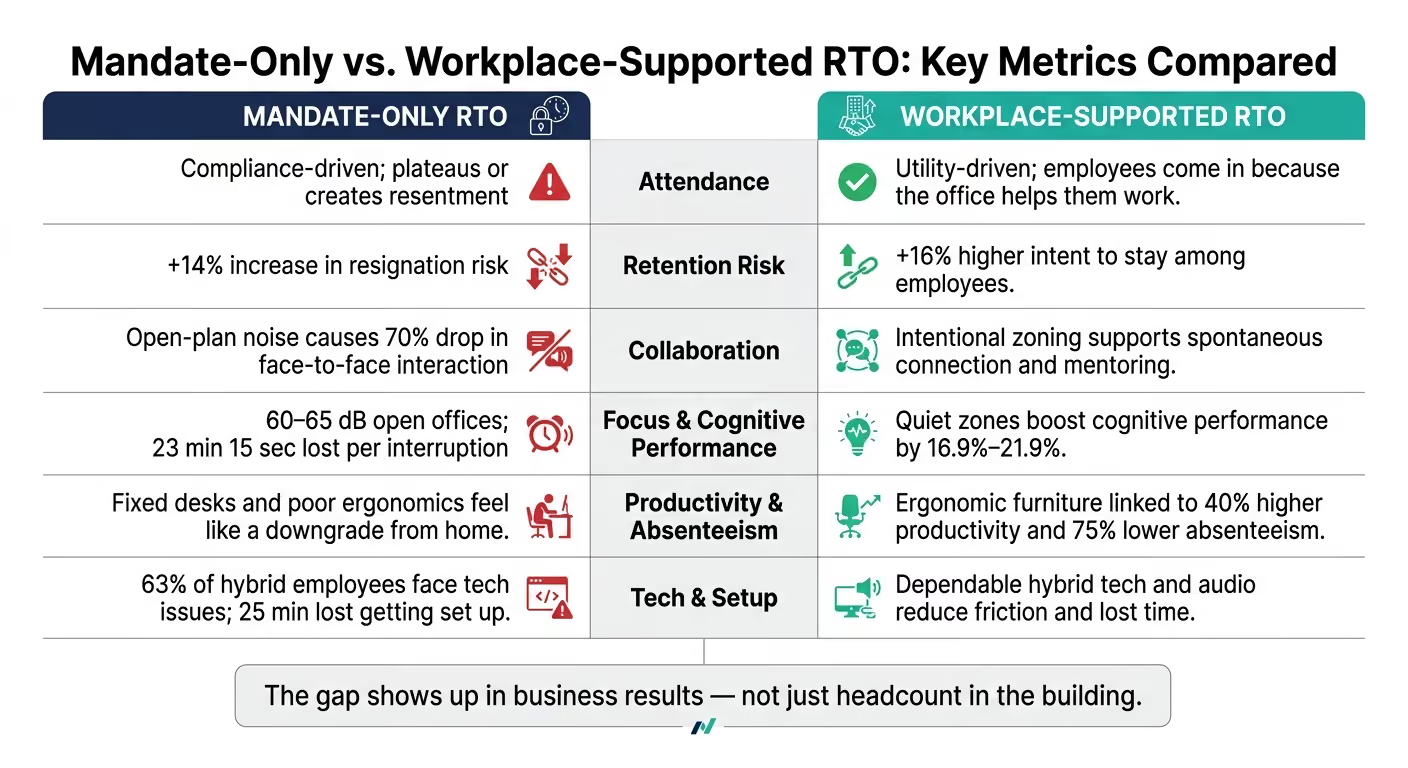
Mandate-Only vs. Workplace-Supported RTO: A Side-by-Side Comparison
The split between these two approaches shows up in the numbers that matter to business performance.
The key point is simple: the gap shows up in business results, not just headcount in the building. Once those target outcomes are clear, the next move is to measure whether the workplace is helping produce them.
How to Design the Office Around Measurable Business Outcomes
Now that the business case is clear, the next step is simpler: which design choices move which metrics?
Collaboration and Innovation Gains
One of the biggest levers is zoning. Separate quiet focus areas from spaces built for collaboration. Activity-based zones are linked to productivity gains of 10% to 25% [4]. The reason is pretty simple. When people have a place to concentrate without interruption, they’re more likely to use shared spaces when teamwork will actually help. Add sound control like panels, baffles, and masking to reduce speech distraction [4][1].
Meeting room mix matters too. A common fix is to stop overinvesting in large rooms that sit half empty. Based on utilization data, organizations can turn an underused 12-person boardroom into three 4-person huddle rooms [5]. That gives teams more room options and cuts down on empty-room bookings.
As one Office Gallery client said after a strategic workspace redesign:
"The collaboration outcome has been the most meaningful operational result... people walk by one another and connect spontaneously without scheduling meetings." [7]
Hybrid meetings also need to work without drama. If the audio is bad, the whole meeting falls apart. 81% of professionals rank audio as the top factor in successful video conferencing [1]. That’s why it makes sense to put microphone arrays and even speaker coverage ahead of camera upgrades. Better audio lowers friction and helps remote participants stay part of the conversation. In practice, that turns office attendance into something you can tie to collaboration gains.
Culture Reinforcement and Talent Development
Shared lounges, café seating, high-top tables, and informal gathering spots do more than fill floor space. They create the conditions for mentoring and day-to-day culture to show up in plain sight. When casual interaction feels easy, people talk more, help more, and learn faster.
That kind of setup also helps people see work happening across teams. It builds visibility, speeds up learning, and makes culture feel lived-in instead of written down in a policy document. Formal meeting rooms still have their place, of course, but they usually don’t produce the same kind of casual exchange on their own.
Retention and Hiring Outcomes
The office now plays a direct role in retention and hiring. During remote work, many employees built ergonomic home setups that work well for them. So when they come into an office with basic furniture, poor acoustics, or clunky meeting tech, it can feel like a step backward.
That gap has business effects. Stricter return-to-office mandates without workplace improvements are linked to a 14% rise in resignations, especially among senior staff and women [2]. Ergonomic parity, acoustic comfort, and dependable hybrid tech help remove the friction that pushes people toward disengagement or leaving. In that sense, these choices are cost-control tools, not extras.
Hiring is tied to this too. Candidates notice whether the office fits the way the company says it works. If the space supports focus, collaboration, and hybrid work, that sends one message. If it doesn’t, that sends another. The next step is to track whether those changes are improving retention and hiring outcomes.
"When you have the data in front of you, the conversation shifts from opinions to facts. You can clearly see how people are using the space." - Mike Troia, CEO, Office Gallery [5]
How to Measure Return on Workplace Investment
Start with a baseline. Before any money goes out the door, run a 30-day audit of how your space performs now [2]. Look at badge swipes, booking software logs, and sensor data so you can see which desks, rooms, and zones people use - and which ones sit empty.
That distinction matters. Occupancy tells you who came in. Utilization tells you whether the space actually worked for them [5]. Once you have that baseline, you can connect workplace changes to business outcomes like collaboration, innovation, culture, and retention.
Baseline Metrics, Leading Indicators, and Lagging Indicators
You need to track both early signs and longer-term results if you want a clear read on whether the workplace is helping the business.
Leading indicators show friction early. These include peak utilization rates, booked-but-empty rooms, employee sentiment surveys, and the time people spend getting set up when they arrive. That last one adds up fast: hybrid workers lose about 25 minutes getting set up when they arrive [1].
Lagging indicators take more time to move, but they’re often the numbers that matter most in a business case. Think retention and attrition rates, absenteeism, lower operating costs, and productivity output.
A Practical ROI Formula for Workplace Decisions
The math is straightforward:
(Measured Business Benefits − Workplace Investment) ÷ Workplace Investment
Stick to benefits you can measure: avoided turnover, recovered productivity, lower absenteeism, and less real estate waste.
For example, replacing one employee usually costs between 50% and 200% of their annual salary [1][3]. And if a 10,000-square-foot office is running at 35% utilization, roughly $260,000 in annual rent is at risk [5]. That’s not just a space issue. It’s a money issue.
Once those numbers are on the table, you can turn them into a workplace plan that supports RTO performance.
Building a Boston-Area RTO Strategy With Office Gallery
Once your ROI metrics are in place, the workplace needs to back them up. That means putting those metrics into the space itself - using layout, furniture, acoustics, and tech to support the behaviors the business wants more often.
Workplace Solutions That Support RTO Performance
Office Gallery works with Greater Boston organizations from planning through installation. It starts with space planning and design, then turns that into a workspace plan tied to the outcomes you're tracking: collaboration, focus, retention, and hybrid performance.
That work can include the entire office, such as:
- Private offices
- Workstations
- Conference and training rooms
- Ergonomic seating
- Height-adjustable desks
- Acoustic treatments
- Reception areas
- Breakrooms
Each part of the space connects back to the drivers the business is measuring, especially collaboration, focus, and retention.
A BTL Industries expansion showed how a redesign can support growth, improve employee feedback, and increase spontaneous collaboration. [7]
Local Support for Greater Boston Organizations
For Boston-area organizations, that support also needs to be local, fast, and simple to access. Office Gallery serves organizations across Greater Boston and has a showroom in Norwood at 151 Carnegie Row. [6] Being nearby can mean faster site visits, easier coordination, and quicker adjustments after installation.
"A workplace designed for modern work brings people back consistently." [1]
Office Gallery helps Boston-area businesses build workplaces that turn RTO into measurable business outcomes.
FAQs
How do you measure RTO ROI?
Measure RTO ROI by looking at workplace performance, not just whether people follow the policy. Start by spotting the friction points that make office time less useful: noise, limited privacy, or weak hybrid tech.
Then track what changes in areas like:
- productivity and output
- retention and attrition
- operational efficiency
- behavioral shifts like collaboration and workplace pride
When those numbers move in the right direction, the office starts to look like a business asset instead of just overhead.
What office changes improve RTO results most?
The most effective changes treat the workplace as a performance investment, not just a policy tweak. The goal is simple: build a space that helps people do their best work.
A smart place to start is activity-based zoning. In plain English, that means giving different kinds of work their own spaces. Quiet, heads-down tasks need calm areas. Team discussions need room to talk. When you separate focus zones from collaborative spaces, you can cut noise-related productivity loss and make the office work better for everyone.
The upgrades that tend to matter most include:
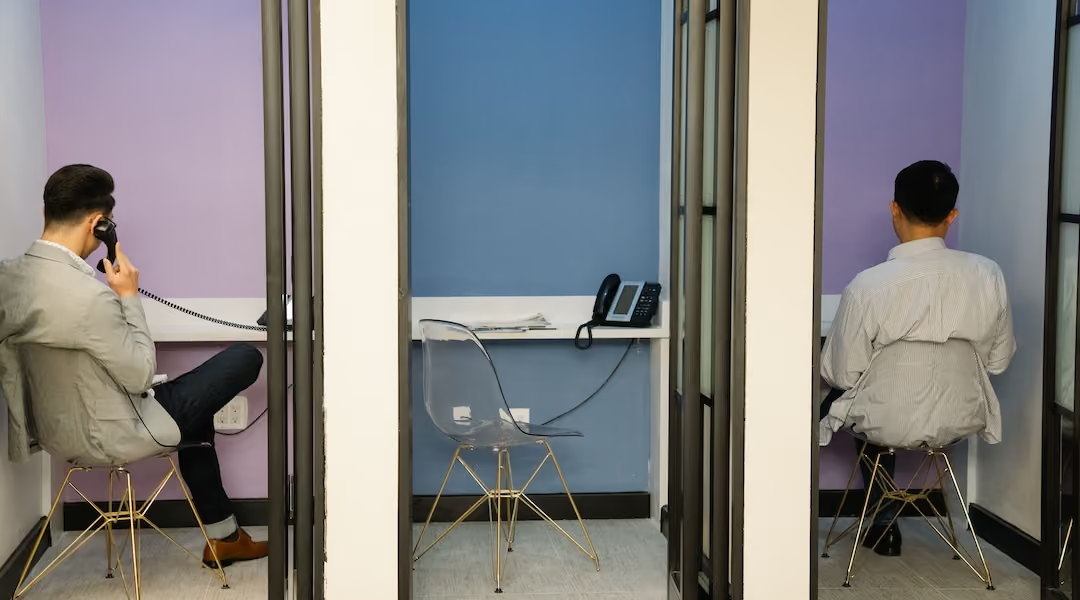
- Enclosed quiet rooms and phone booths for focused work and private calls
- Ergonomic seating and height-adjustable desks to support comfort during long workdays
- Hybrid-ready meeting technology so in-office and remote team members can join on equal footing
- Modular furniture paired with acoustic treatments to make spaces easier to shift and less distracting
What metrics should we track first?
Start with a 30-day audit to see where your office falls short for the people who use it every day. Ask employees what gets in the way of good work, whether that’s noise, not enough privacy, or hybrid tech that doesn’t hold up in meetings.
At the same time, track space utilization data, not just occupancy. That gives you a clearer picture of how desks, meeting rooms, and collaboration areas are used in practice, not just whether someone checked in. Look at booking-versus-use logs, then compare peak and average utilization to spot gaps between demand and actual use.
•••••
The right workplace design measurably improves employee performance, satisfaction, and retention. Office Gallery partners with businesses on that strategy, and welcomes architects and interior designers looking for a furniture and space-planning partner on their own projects. Contact the team at 781-762-3733, email info@officegallery.net, or visit the showroom at 151 Carnegie Row in Norwood.
Key Points
What separates a mandate-only RTO strategy from a workplace-supported one?
- Compliance versus utility: Mandate-only attendance is compliance-driven and tends to plateau or create resentment, while workplace-supported attendance is utility-driven, employees come in because the space actually helps them work.1
- Collaboration quality: Forced proximity without design intent produces high digital distraction, while intentional zoning supports genuine spontaneous and planned connection.4
- Innovation impact: Unmanaged noise environments cost roughly 23 minutes of recovery time per interruption, while protected focus zones can boost cognitive performance by up to 21.9 percent.1
- Mentorship: Mandate-only offices leave mentorship incidental, while workplace-supported design increases in-person mentoring time by roughly 25 percent.3
- Retention signal: Mandate-only approaches are tied to a 14 percent rise in resignation risk, while workplace-supported approaches are tied to meaningfully higher intent to stay.[1][3]
- What to measure: Track badge data against voluntary attendance rates, meeting effectiveness, employee development scores, eNPS, and voluntary turnover to see which approach a given office is actually running.
What design choices move collaboration and innovation metrics?
- Activity-based zoning: Separating quiet focus areas from collaboration spaces is linked to productivity gains of 10 to 25 percent.4
- Sound control: Acoustic panels, baffles, and sound masking reduce speech distraction across open layouts.[4][1]
- Meeting room right-sizing: Converting an underused 12-person boardroom into three 4-person huddle rooms is a data-driven fix based on actual utilization patterns.5
- Audio investment priority: 81 percent of professionals rank audio as the top factor in successful video conferencing, ahead of camera quality.1
- Real client outcome: One Office Gallery client reported that spontaneous, unscheduled collaboration became the most meaningful result of a workplace redesign.7
- Measurable link: These design choices tie office attendance directly to collaboration outcomes leadership can track, not just headcount in the building.
How does office design affect mentoring and culture?
- Informal gathering spaces: Shared lounges, cafe seating, and high-top tables create natural conditions for mentoring and culture to happen in passing, not by appointment.
- Visibility across teams: Casual, easy-to-access interaction spaces let employees see work happening across teams, speeding up organizational learning.
- Culture made visible: Well-placed informal space makes culture feel lived-in day to day rather than something that only exists in a written policy document.
- Formal rooms fall short alone: Traditional meeting rooms still serve a purpose, but they rarely produce the same casual exchange that informal space generates on its own.
- Compounding effect: Easier casual interaction means people talk more, help more, and learn faster, effects that build over time rather than showing up immediately.
- Connection to retention: Stronger mentoring and cultural visibility are part of what closes the gap that drives the 14 percent rise in resignations tied to mandate-only approaches.2
What should a 30-day workplace audit measure?
- Badge swipes: Building-level attendance data establishes who is actually coming in and when.
- Booking software logs: Reservation data shows demand for meeting spaces, though it can overstate real usage on its own.
- Sensor data: Desk- and room-level sensors reveal which spaces are genuinely active versus just reserved.5
- Occupancy versus utilization: Occupancy shows who showed up; utilization shows whether the space actually worked for them, a distinction that changes what gets fixed.5
- Setup and friction time: Time lost to technology issues on arrival, averaging 25 minutes for hybrid employees, is a leading indicator worth tracking from day one.1
- Baseline before spending: Running this audit before any workplace investment is made ensures later results can be measured against a real starting point, not a guess.
What real numbers belong in a workplace ROI calculation?
- Employee replacement cost: Replacing one employee typically costs 50 to 200 percent of their annual salary.[1][3]
- Rent at risk: A 10,000 square foot office running at 35 percent utilization puts roughly $260,000 a year in rent at risk.5
- Resignation risk: Stricter RTO mandates without workplace improvements are linked to a 14 percent rise in resignations.2
- Absenteeism reduction: Ergonomic furniture investment is linked to a 75 percent decrease in absenteeism.1
- Lost productivity time: Noise-related interruptions and hybrid tech friction combine to cost employees real, trackable minutes every workday.1
- The formula itself: Measured business benefits minus workplace investment, divided by workplace investment, only produces a meaningful number when every input above is tracked consistently over time.
What role does Office Gallery play in building an RTO strategy around these metrics?
- Space planning through installation: Office Gallery works with Greater Boston organizations from initial planning through final installation, not just furniture delivery.
- Full scope of spaces: Coordination can cover private offices, workstations, conference and training rooms, ergonomic seating, height-adjustable desks, acoustic treatments, reception areas, and breakrooms.
- Metrics-driven approach: Each part of a project connects back to the specific outcomes a client is tracking, particularly collaboration, focus, and retention.
- Proven outcome: A BTL Industries expansion demonstrated measurable gains in employee feedback and spontaneous collaboration following a redesign.7
- Local presence: A Norwood, MA showroom at 151 Carnegie Row supports faster site visits and quicker post-installation adjustments for Greater Boston clients.6
- Data-driven conversations: Utilization data shifts planning conversations from opinion to fact, letting a client see exactly how a space is being used before committing to changes.5