
What Employees Actually Want From the Office in 2026
92% of employees rank collaboration and community as their top reason to come into the office, and 79% say it helps them focus, but rigid mandates still drive people away. The data points to design, not policy, and Office Gallery breaks down what actually closes the gap.
Post Summary
Employees say they will come into the office when it gives them something useful, not simply because leadership asks them to. 91% say they can be convinced to come in if the office offers something worth the trip, and the leading reasons are consistent: 92% rank collaboration and community at the top, 79% say the office helps them focus, and 52% prefer in-person mentoring. Boston-area conditions raise the stakes further, with 85% of local businesses running hybrid schedules, 72% letting staff choose their in-office days, and office vacancy sitting near 20% to 21%. That combination means underused or poorly equipped space is a visible cost rather than a background inconvenience. The clearest takeaway is that attendance follows utility. When the office solves a real problem for the person walking in, they show up. When it does not, no policy closes that gap on its own.
Collaboration and community consistently rank as the top reason employees choose to come in, with 92% of employees citing it in Cisco's 2025 Global Hybrid Work Study and roughly three-quarters citing team connection specifically in CBRE's Workplace Strategy Employee Survey, including 66% who point to face-to-face collaboration in particular. These numbers reflect what people say they miss most when working apart: hallway conversations, quick follow-ups after meetings, and informal check-ins that do not need a calendar invite. That makes attendance a voluntary pull rather than a rule people comply with, and it points to the office's remaining advantage over remote work, which is easier human interaction. Early-career employees weigh this even more heavily, since they are still building relationships and picking up context that rarely comes through on a screen. Any office strategy aimed at attendance has to treat this as the primary draw, not a secondary benefit.
Focus support runs a close second to collaboration in what makes an office day worth it. 79% of employees say coming in improves their ability to focus, and 43% now say they focus better in the office than at home, compared with 34% who say the same about home. Employees consistently point to quiet, control over their immediate space, reliable technology, and ergonomic seating as the features that make that possible, and roughly half rank quiet specifically as a top priority. Sound masking alone has been shown to cut office distractions by 25% and recover about 21 minutes of lost productivity per employee per day, while ergonomic upgrades like sit-stand desks can reduce back and neck pain by 54% and improve output by 15%. When an office is noisy, crowded, or poorly equipped, the commute starts to feel like a bad trade, which is why focus infrastructure matters as much as collaboration space.
Mentoring is one of the clearest, most measurable reasons employees still choose to come in, particularly early in their careers. Employees spend roughly 25% more time mentoring and being mentored in the office compared with remote work, and 52% say they prefer being mentored in person rather than at home. The reason is practical: a junior employee can watch how a senior colleague handles a difficult client call, ask a quick follow-up after a meeting, or get feedback immediately after a presentation, and those moments are difficult to recreate over video. Visibility matters alongside mentoring itself, since employees also value being seen, included, and physically near decision-makers. Offices that treat mentoring as incidental rather than designed for are leaving one of the strongest voluntary attendance drivers unaddressed.
Rigid mandates tend to produce the opposite of their intended effect. 42% of companies reported higher than expected attrition after requiring a return to the office, and Gartner found that mandates can drop high performers' intent to stay by 16%, with the damage concentrated among high performers, women, and millennials specifically. A large academic study found a consistent pattern from a different angle: mandates produced clear drops in job satisfaction with no meaningful improvement in firm financial performance or firm value. Broad culture messaging fares no better, since telling employees the company values in-person work does little when the office itself feels flat or generic. Employees do not respond to vague appeals to culture, they respond to specific moments that feel worth the trip, such as a project kickoff, a mentoring session, or a cross-team workshop. When mandates substitute for a genuinely useful office, the result is compliance at best and resignations at worst.
Most employees are not against the office. They just want a reason to go. In 2026, the data is pretty clear: people come in for team connection, face-to-face work, quiet focus, good equipment, and mentoring. They do not come in just because leaders say they should.
Summing it up, we’d say::
- 91% of employees say they can be convinced to come in if the office gives them something useful
- 92% rank collaboration and community as top reasons to show up
- 79% say the office helps them focus
- 52% prefer in-office mentoring
- Poor office conditions can hurt retention, while rigid return rules can push people out
For Boston-area companies, this matters even more. With 85% of businesses using hybrid work, 72% letting staff pick in-office days, and office vacancy near 20% to 21%, space has to work harder.
So the answer is simple: if you want people in the office, build around what they ask for.
That usually means:
- Quiet areas for focus
- Rooms and seating for group work
- Good video meeting tools
- Ergonomic desks and chairs
- Space for informal chats
- Clear reasons to come in on shared team days
- Safe, comfortable layouts with open walkways and clear exits
Here’s the core gap in one view:
Making office decisions in 2026, we start with one move: ask employees what gets in the way. Noise, weak hybrid meeting setup, lack of privacy, poor seating, and empty desk rows are fixable problems. A better office starts there.
![What Employees Actually Want From the Office in 2026 [Key Stats]](https://cdn.prod.website-files.com/6331b625a638a0306046086a/6aa966fae307838b9ca403ff_6a9e04ee180d85018c31afbc-1788747380505.avif)
What employees say they want from the office in 2026
Collaboration and social connection are the top reasons people come in
Employees tend to come into the office when it helps them do things that are harder to do at home. Employees come in for people, not desks. In Cisco's 2025 Global Hybrid Work Study, 92% of employees ranked collaboration and community as top reasons to come in.[10] CBRE's Workplace Strategy Employee Survey found that about three-quarters cited team connection and community as the main reason to come in, with 66% citing face-to-face collaboration specifically.[11]
That lines up with what people miss most when they work apart: hallway conversations, quick follow-ups after meetings, and coffee chats that don't need a calendar invite. This is a voluntary pull, not just a rule people comply with. It shows the office still has one big edge over remote work: easier human interaction.
Age and career stage shape this too. Early-career employees often put more weight on in-person time because they're still building relationships, learning how things work, and picking up context that doesn't always show up on a screen.
Focus spaces, reliable tools, and ergonomics make the office more useful
Collaboration gets most of the attention, but focus is close behind. Cisco found that 79% of employees said coming into the office improves their ability to focus.[10] Owl Labs' 2025 data shows that 43% now say they focus better in the office, compared with 34% who say the same about home.[8]
What helps? Employees point to acoustic control, reliable technology, ergonomic seating, and height-adjustable desks. Corgan's Hybrid Report found that quiet (50%) and the ability to control their space are top qualities people want for focus work.[7] If the office is noisy, crowded, or poorly equipped, the commute starts to feel like a bad trade.
Even small changes can matter. Sound masking technology can reduce office distractions by 25% and save employees an average of 21 minutes of lost productivity per day.[5]
Ergonomics also has a clear effect. Sit-stand desks have been shown to reduce back and neck pain by 54%, and ergonomic setups more broadly can reduce physical discomfort by 22% while boosting productivity by 15%.[6] For employees without a proper home office, a well-equipped workstation is a concrete reason to come in. That's why quiet space and dependable tools matter just as much as areas built for group work.
Mentoring, learning, and visibility still draw employees on-site
For early-career employees in particular, the office offers something remote work still struggles to match: access to people who can help them grow. WFH Research data shows that employees spend about 25% more time mentoring and being mentored when they're in the office compared with working remotely.[9] Owl Labs' 2025 report found that 52% of employees prefer being mentored in the office rather than at home.[8]
That makes sense. A junior employee can watch how a senior colleague handles a tense client call, ask a quick follow-up after a meeting, or get feedback right after a presentation. Those moments build career capital, and they're hard to recreate over video.
Employees also care about access to leadership. Being seen, being included, and being near decision-makers still matter. Those preferences shape where employers get RTO wrong.
Where employer assumptions still miss the mark
Employees have already been pretty clear about what they want. The problem now is that many leaders still plan office attendance around old assumptions.
Mandates and broad culture messages do not drive voluntary attendance
A lot of leaders still believe minimum in-office rules will bring culture back and fill seats again. The data says otherwise.
Rigid mandates hurt retention, especially for high performers, women, and millennials. They’ve also led to surprise turnover: 42% of companies reported higher-than-expected attrition after requiring employees to return to the office, and Gartner found that high performers’ intent to stay drops 16% under rigid mandates.[22][18][23]
A large academic study found the same pattern from another angle: RTO mandates led to clear drops in job satisfaction, but no meaningful change in firm financial performance or firm value.[14][19] So this isn’t just about policy. It’s also about whether the office gives people a reason to be there.
The same problem shows up in broad culture messaging. Telling employees the company is built around in-person work doesn’t do much when the office itself feels flat or generic.[12][13][17] People don’t come in for vague ideas. They come in for specific moments that feel worth the trip, like a project kickoff, a mentoring session, or a cross-team workshop.[15][16][17]
When culture messaging feels more like control than purpose, employees tend to do the bare minimum or start looking for another job.[12][13]
Employees want planned on-site work, not assigned-desk layouts
The issue isn’t attendance by itself. It’s whether the day feels worth the commute.
In Microsoft’s 2022 Work Trend Index, 38% of hybrid employees said their biggest challenge was knowing when and why to come in.[20] That points to a planning problem, not a motivation problem.
What people want is pretty simple: an office set up for work that matters. That means space for collaboration, quiet focus, learning, and growth, not long rows of assigned desks that sit half empty. BCG’s flexible working research found that employees were eight times more likely to want to work in person for affiliation and development than for focus or administrative tasks.[21]
The mismatch gets easier to see when employer assumptions are lined up next to what employees say they want.
Office design investments that close the gap
Build separate zones for focus, meetings, and informal connection
People come into the office when the space helps them do the kind of work they have that day. That’s why it makes sense to divide the office into zones for focus, meetings, and informal connection.
A setup like this gives people options. Someone who needs quiet can use a focus area. A team that needs to talk can head to a meeting space. And informal seating, paired with clear walkways, makes it easier for people to bump into each other and talk without stuffing the calendar with even more meetings. The office has to handle focus, movement, and connection all at once.
Treat safety, comfort, and fire egress as part of everyday workplace quality
Safety belongs in the day-to-day office experience. It shouldn’t sit off to the side as a facilities-only concern.
Good space planning covers ventilation, natural light, clear circulation paths, and unobstructed egress. Those are basic signs of a safe office, and people notice them. They send a simple message: the company pays attention to the physical space people work in.
That matters more than some leaders think. 21% of workers say they’d consider looking for another job specifically because of poor indoor air quality [1]. So this isn’t just about compliance. It ties directly to retention.
Use turnkey planning and furniture selection to support hybrid work
Once the layout works, hybrid teams still need the right tools and furniture to make the office usable. Knowing what to buy is one thing. Getting it in place fast is just as important, especially when headcounts shift.
Ergonomic seating, height-adjustable desks, and modular furniture do more than make people comfortable. Height-adjustable workstations can reduce physical discomfort by 22% and increase output by 15% [3]. And when you look at the cost side, the math gets pretty plain: replacing one employee due to poor workplace satisfaction can cost between 50% and 200% of that employee’s annual salary [1]. Compared with that, furniture spending is easier to justify.
Hybrid-ready planning also needs to include tech. Meeting zones need video conferencing tools that work without drama, and bookable focus rooms help teams use space only when it earns its keep [2]. Turnkey planning helps teams put these changes in place faster.
Conclusion: What makes the office worth coming back to in 2026
The research points in the same direction: people come back when the office earns the commute. Teams show up for better collaboration, deeper focus, more comfort, and the kind of informal connection that rarely happens at home. What they don't come back for is a mandate. In fact, forcing attendance without fixing the workspace can increase resignations by 14% [1].
That employer-employee gap is still there in 2026. Employers want attendance. Employees want a clear reason to make the trip. Closing that gap comes down to design, not policy.
The next move is pretty straightforward. Start by finding the specific barriers that keep people away. Survey first. Then design around what you learn, whether that's noise, lack of privacy, weak hybrid tech, or a layout that gets in the way. Zone the space, protect safety and egress, and set it up for hybrid work. Once the office is built around those answers, it starts to feel worth the commute.
Key takeaways for business owners and office decision-makers
Before spending money on a redesign, measure the gap first. Ask your team what's actually holding them back - noise, poor privacy, weak hybrid tech, or something else.
That answer should shape every dollar that comes next. Survey the barriers, design for the work people actually do, and give people a reason to come in.
FAQs
How often should hybrid teams come into the office?
There’s no one-size-fits-all answer. Research shows the right hybrid schedule depends on an organization’s day-to-day needs and how its teams work together.
So instead of locking in a fixed number of office days, the smarter move is to make the office somewhere people actually want to go. That means a space built for collaboration, social connection, and focused work.
What office upgrades make the biggest difference first?
Start with upgrades that make work feel better day to day and help people work well together.
High-quality ergonomic chairs are one of the clearest wins. They offer an immediate step up from many home office setups, and that kind of comfort can matter for long-term retention.
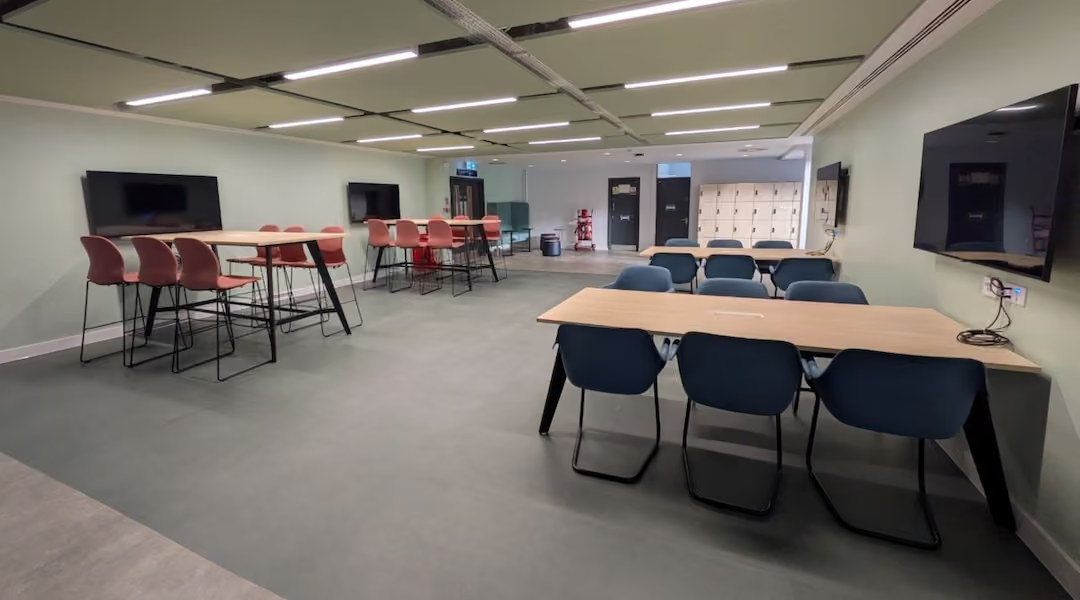
At the same time, improve break rooms and collaborative areas with high-top tables and flexible seating. These spaces should feel easy to use, whether someone wants a quick chat, a casual meeting, or a place to reset between tasks.
It also helps to add sound masking to manage noise. That way, active spaces stay lively without spilling into areas meant for deep, focused work.
How can employers give people a real reason to come in?
Make coming in feel easier than staying home by designing for the work moments employees want: comfort, focus, and smooth collaboration.
Invest in ergonomic seating and adjustable workstations. Set up distinct zones for quiet focus, team work, and casual social connection. Back it up with hybrid-ready tech that works without friction, including booking tools, strong Wi‑Fi, and meeting rooms built for hybrid calls.
•••••
If your office is ready for a similar transformation, whether you're in the Greater Boston area or farther out in Southern New England, we'd love to talk. Visit our showroom at 151 Carnegie Row in Norwood, or call us at 781-762-3733 to schedule a consultation.
Key Points
What does the collaboration and community data reveal about the true pull factor for office attendance?
- 92% of employees rank collaboration and community as their top reason to come in -- ranking this far above other factors in a major 2025 study confirms attendance is driven by relationships, not by policy compliance or vague culture messaging [10]
- Roughly three-quarters cite team connection as their main reason to show up, with 66% specifically pointing to face-to-face collaboration -- corroboration across two separate studies, Cisco and CBRE, strengthens the finding rather than leaving it dependent on a single data source [11]
- Early-career employees weigh in-person time more heavily than tenured staff -- this suggests attendance strategy should differ by career stage, with junior-heavy teams needing more built-in collaboration infrastructure than senior-heavy ones
- Hallway conversations and unplanned follow-ups are the specific moments employees say they miss most -- these are structurally difficult to replicate on video, which is why the office retains a real functional edge over remote work rather than just a cultural one
- Attendance driven by collaboration functions as a voluntary pull rather than a rule people comply with -- voluntary attendance is more durable than mandate-driven attendance because it does not require ongoing enforcement or generate the resentment a mandate can create
- The gap between wanting collaboration and having space built for it is where most offices lose people -- an office that offers no meaningfully different collaboration experience than a video call gives employees no reason to trade the commute for it
What does the research on focus and ergonomics reveal about the office's competitiveness against home?
- 79% of employees say the office improves their ability to focus -- a figure this high indicates the office can outperform home on concentration when it is properly designed, contradicting the assumption that home is inherently better for deep work [10]
- 43% now say they focus better in the office versus 34% who say the same of home -- this nine-point swing shows the home-versus-office focus advantage is closer and more design-dependent than commonly assumed [8]
- Quiet ranks as a top priority for roughly half of employees seeking focus conditions -- this identifies acoustic control as the single highest-leverage focus investment rather than one factor among many [7]
- Sound masking reduces office distractions by 25% and recovers about 21 minutes of productivity per employee per day -- a recovery of this size compounds across a workforce into a measurable productivity gain, not just a comfort improvement [5]
- Sit-stand desks reduce back and neck pain by 54% -- pain reduction at this scale changes ergonomic furniture from a perk into a retention-relevant health investment [6]
- Ergonomic setups broadly reduce physical discomfort by 22% while increasing output by 15% -- pairing a comfort gain with a productivity gain gives ergonomic investment a business case beyond employee satisfaction alone [6]
What does the mentoring and visibility data reveal about why early-career employees still value the office?
- Employees spend about 25% more time mentoring and being mentored in the office than remotely -- a gap this size shows mentoring specifically depends on physical proximity in a way that other collaboration types may not [9]
- 52% of employees prefer being mentored in person rather than at home -- a majority preference this clear should push mentoring-heavy roles and teams toward higher in-office expectations than the organization's general policy [8]
- Junior employees gain feedback and context through moments like a follow-up after a meeting or a debrief after a presentation -- these are informal, unscheduled interactions that structured video calls rarely replicate, since they depend on physical presence and timing rather than a booked slot
- Visibility near decision-makers matters to employees independent of mentoring itself -- being seen and included functions as its own attendance driver, meaning office design should create natural proximity to leadership, not just meeting rooms
- Mentoring value compounds career capital over time rather than delivering an immediate, visible return -- this makes mentoring easy for leadership to underweight when justifying office investment, even though employees consistently rank it as a top priority
- Offices without spaces designed for informal coaching and drop-in conversation leave a strong voluntary attendance driver unaddressed -- treating mentoring space as optional rather than designed-for wastes one of the clearest, most consistently cited reasons employees choose to come in
What does the mandate research reveal about the actual cost of forcing attendance instead of earning it?
- 42% of companies saw higher-than-expected attrition after mandating a return to office, with the damage concentrated among high performers, women, and millennials, and high performers' intent to stay dropping 16% under rigid mandates -- attrition risk this specific and this concentrated turns a general retention worry into a named, quantifiable planning risk [18][22][23]
- Mandates produced clear drops in job satisfaction with no meaningful gain in firm financial performance or value -- this removes the main financial justification typically used to defend stricter attendance policy [14][19]
- Broad culture messaging does not increase voluntary attendance when the office itself feels flat or generic -- messaging cannot substitute for a physical environment that gives people a real reason to be there [12][13][17]
- Employees respond to specific, worth-the-trip moments rather than general appeals to culture -- this points design and scheduling toward concrete events, like kickoffs and workshops, rather than vague in-person value propositions [15][16][17]
- Mandate-driven attendance requires ongoing enforcement, while attendance earned through design does not -- this distinction is why a mandate alone rarely produces a durable change in behavior, only a temporary compliance spike
- When mandates substitute for a genuinely useful office, the likely outcomes are compliance at best and resignations at worst -- this frames the mandate-versus-design choice as a real trade-off with measurable downside, not a neutral policy decision
What does the survey data on desk assignment and planning reveal about why attendance still feels arbitrary to employees?
- 38% of hybrid employees say their biggest challenge is knowing when and why to come in -- a confusion this widespread points to a scheduling and communication failure sitting on top of the design failure, not a separate issue [20]
- Employees are eight times more likely to want in-person time for affiliation and development than for focus or administrative tasks -- this ranks collaboration and mentoring investment above quiet-work investment when resources are limited, since employees themselves weight it far higher [21]
- Assigned desk rows read as a sign of commitment to leadership but not to employees -- this mismatch means investment in static desk assignment can go entirely unrewarded in attendance or sentiment
- Flexible, activity-based space is what employees report actually wanting in place of fixed seating -- redesigning around activity rather than headcount aligns space with how people say they choose to spend an office day
- Commute time and cost function as a real, named barrier rather than background friction, especially in metro areas -- treating commute cost as a legitimate constraint, not just a complaint, should shape how many and which days matter most
- Clustering on-site days and reducing unnecessary trips directly answers the commute barrier -- this is a scheduling fix that costs nothing to implement and can be paired with any physical redesign
What does the safety, ergonomics, and cost data reveal about the business case for closing the RTO gap?
- 21% of employees would consider leaving a job specifically over poor indoor air quality -- a figure this specific moves air quality out of a facilities afterthought and into a named, measurable retention risk [1]
- Replacing an employee lost to poor workplace satisfaction can cost 50% to 200% of that employee's annual salary -- a cost range this wide still exceeds the price of most office upgrades, which is what makes design investment defensible against inaction [1]
- Forcing attendance without fixing the workspace can increase resignations by 14% -- this quantifies the downside risk of choosing policy over design as the primary lever [1]
- Height-adjustable workstations reduce physical discomfort by 22% and increase output by 15% -- pairing a comfort gain with an output gain strengthens the return-on-investment case for ergonomic spending specifically [3]
- Office neighborhoods and focus pods are linked to better focus and higher job satisfaction in personality-environment research -- this ties a specific, buildable design feature to two separate outcome measures rather than a single vague benefit [4]
- Turnkey planning that bundles furniture, zoning, and hybrid technology moves faster than piecemeal purchasing -- speed matters because headcount and space needs shift, and a coordinated plan adapts faster than upgrades made one room at a time [2]