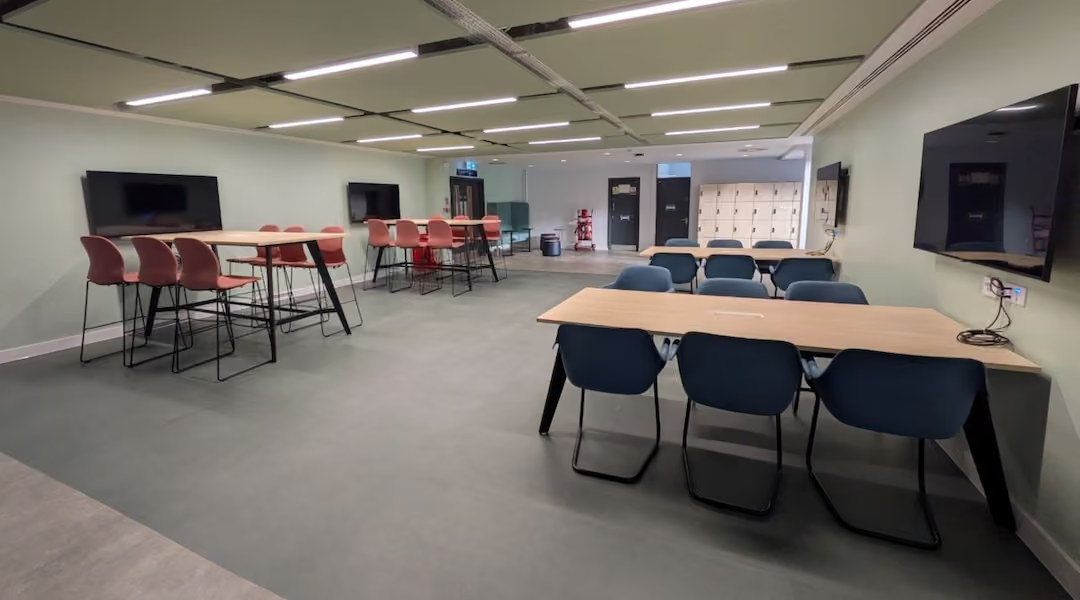

Why the Best Office Investments Pay Off in Ways That Don't Show Up on the Balance Sheet
Office investments pay off in dollars and in ways that don't show up on a balance sheet: belonging, pride, mentorship, and collaboration. This guide shows Greater Boston leaders how to set a baseline, measure both financial and human outcomes, and avoid crediting the office for changes it didn't cause.
Post Summary
It's not just cost savings. The best office investments also build belonging, pride, mentorship, and collaboration — outcomes that matter even when they don't show up as a dollar figure.
Track four areas together: costs like turnover and energy use, daily work quality like focus and meeting effectiveness, employee experience like comfort and belonging, and talent outcomes like retention intent.
No. Research on open-plan conversions found roughly a 70% drop in face-to-face interaction, so shared space works best when it's paired with quiet rooms and private areas people can choose.
Employees spend about 25% more time mentoring and being mentored in the office than remotely, and shared spaces that support informal exchange help drive that connection.
Set a baseline first. Gather space-use data, employee survey responses, and turnover and absenteeism trends so results after move-in can be compared against real starting numbers.
We judge an office investment by what it saves - and how it helps people work. Start with a 30-day space-use audit and employee survey to find problems with noise, privacy, comfort, and teamwork before spending on a new layout.
The returns aren’t always dollars. Employees spend about 25% more time mentoring and being mentored in the office than remotely. [2] But more shared space isn’t always the answer: research on open-plan conversions found roughly a 70% drop in face-to-face interaction. [7]
Here’s what we'd measure:
- Costs: Turnover, absenteeism, energy, and space use.
- Daily work: Focus, meeting quality, and collaboration.
- Employee experience: Comfort, belonging, pride, and connection.
- Talent: Intent to stay, actual departures, and offer acceptance.
Let's pair quiet rooms with shared areas, then repeat the same measurements after move-in. Better survey scores are early signals - not proof of savings. For Greater Boston teams, that means starting with the work your space needs to support, not the furniture order.

Legal Management Talk: Office Design and Employee Wellness with Heather Oden and Amalia Mohr
The Business Value of Belonging, Pride, and Connection
That baseline should also measure whether the office builds belonging, pride, and day-to-day connection.
How Belonging and Pride Relate to Commitment
Belonging and organizational pride measure commitment, not just attendance. [1][2]
Use survey items such as “I feel accepted and supported here” and “I am proud of what this organization stands for,” then compare results with retention and referrals.
Track mentoring time, too. Employees spend about 25% more time mentoring and being mentored in the office than remotely. [2] How people use shared spaces can help show these connections in practice.
How Shared Spaces Support Identity and Collaboration
Shared spaces put organizational priorities on display and give employees chances to exchange knowledge informally.
In Office Gallery’s Datasmith client spotlight, the Walpole company doubled its office to 1,600 square feet, with reported improvements in collaboration, creativity, and belonging. [5]
Track cross-team participation and spontaneous conversations in common areas outside scheduled meetings. Ask employees whether those exchanges helped them solve a problem, share useful knowledge, or find the right colleague.
But more interaction doesn't always mean better collaboration. Research on open-plan conversions found roughly a 70% decline in face-to-face interaction. [7] Pair shared areas with quiet rooms and private spaces so people can collaborate by choice without disrupting others.
What Workplace Quality Tells Employees
Shared spaces shape belonging. Workplace quality shapes employees’ trust in the support they get each day. It tells employees whether leadership values how work gets done. They notice the basics: Can they hear a meeting, move around easily, and work without discomfort? Removing those obstacles can support engagement and retention. [2]
Support Comfort, Focus, and Choice
Start with the basics to find where noise, glare, lack of privacy, or layout problems disrupt work. Check for adjustable workstations, clear paths through the space, and unobstructed exits. These conditions affect focus, trust, and retention. [2][3][6]
Match spaces to tasks. Provide quiet areas with few distractions for focused work, small huddle rooms for short discussions, and dependable video conferencing for hybrid meetings. Check ventilation and filtration as well. One survey found that 21% of workers would consider looking for another job because of poor indoor air quality. [2]
Show Organizational Priorities Through Design
Use consistent standards across departments for access to private rooms, suitable lighting, and working meeting technology. Employees shouldn’t need executive status to get a space that helps them do their jobs. [1][2][3]
Ask employees whether the changes help them feel more comfortable and focus better. After move-in, track whether comfort complaints drop and focus ratings improve. Compare that feedback with how people use the space and their risk of leaving.
Measure Financial and Employee Outcomes Together
A workplace designed for focus, connection, and comfort should also be tested: Does it change behavior and costs?
Measure against the business problem the workplace is meant to solve. Track financial, performance, experience, and talent outcomes together. Include belonging and pride, even when you can’t put a price on them.
Use these four lenses to cover each area. Avoid double-counting benefits: reduced turnover and lower replacement costs may reflect the same outcome.
Set a Baseline Before Making Changes
Run a 30-day space-use audit to track occupancy, room use, and booked-versus-used meeting-room time [3][6].
Gather survey responses, interviews, and turnover and absenteeism trends. Select a few measures tied to the business problem. Document the questions, calculation methods, and observation periods so you can repeat the process. Protect confidentiality, especially when results from small teams could identify individuals.
Track Results After Move-In
Use the same measures after move-in to compare like with like. Repeat measurements once employees have settled in, and review space utilization monthly [3].
Treat belonging, pride, and retention intent as early signals - not proof of savings [1]. Track voluntary turnover and actual costs over longer periods. Before crediting the office for a change, account for hiring, pay, leadership, hybrid policy, and seasonality [1][6].
Conclusion: Assess What the Workplace Saves and Enables
Workplace value goes beyond savings. It also includes belonging, pride, collaboration, shared identity, and retention. The next step is to decide what your space needs to solve.
Turn Business Problems Into Workplace Requirements
Start with the business problem: retention concerns, privacy gaps, weak collaboration, hybrid friction, or a space that doesn’t reflect your organization’s values. Set success measures, a budget, and project limits before approving a layout.
A Workplace Performance Partner turns those needs into space planning, ergonomic and acoustic standards, specifications, and implementation [1]. A recent client story shows how this works in practice.
The spontaneous collaboration described in the BTL Industries client story is an operational gain, even when it does not show up as direct savings [1].
Use the Framework in Greater Boston
Office Gallery serves Greater Boston organizations from its Norwood showroom at 151 Carnegie Row, offering workplace consultation, planning, design, and project management [1][5]. For Greater Boston teams, the work starts with the business problem - not the purchase order.
Discuss your workplace objectives with the team or visit the showroom. Bring the problems your space needs to solve, and assess the investment by what it saves and what it helps your team do.
FAQs
How can I justify office spending without a clear financial ROI?
Shift the question from “What’s the balance-sheet ROI?” to “What work friction will this space remove?” Measure space utilization [1] and look at the barriers employees report, including noise, limited privacy, and gaps in rooms used for hybrid meetings.
Link changes to business results. Research on zoning and acoustics cites productivity gains of 10%–25% [2]. Replacing unhappy employees, meanwhile, costs 50%–200% of their annual salary [3]. Track employees’ reactions and behavior after the change to measure success [4].
How can I tell if office changes actually improve retention?
Start with a 30-day audit of everyday frustrations: noise, lack of privacy, unreliable hybrid work tools, or uncomfortable seating.
Once you’ve addressed those issues, track employee feedback and spontaneous collaboration. Use sensor data and booking logs to see how employees use focus and collaboration zones. Also, pay attention to whether employees feel proud to host guests.
These signals help you gauge whether the office supports focus, comfort, and connection - and reduces frustrations that can push employees to leave.
Which workplace improvements should I prioritize on a limited budget?
Reduce noise and help people focus with sound masking, acoustic panels, or both. Use modular furniture and acoustic screens to set up separate zones for collaboration and quiet work. Give small café-style areas and comfortable break spaces an upgrade to help employees feel they belong.
If hybrid meetings aren’t working well, improve the camera, display, and audio setups in the rooms people use most. Measure success through employee feedback and observed behavior - not just costs or desk counts [1][2].
•••••
The right workplace design measurably improves employee performance, satisfaction, and retention. Office Gallery partners with businesses on that strategy, and welcomes architects and interior designers looking for a furniture and space-planning partner on their own projects. Contact the team at 781-762-3733, email info@officegallery.net, or visit the showroom at 151 Carnegie Row in Norwood.
Key Points
What makes office investment returns hard to see on a balance sheet?
- Non-financial returns: The strongest gains from a workplace investment are often behavioral, not financial, and never appear as a line-item saving.
- Belonging and pride as commitment signals: Belonging and organizational pride measure commitment, not just attendance.[1][2]
- Mentoring as a proxy for connection: Employees spend about 25% more time mentoring and being mentored in the office than remotely, a sign the space is supporting connection even when it isn't cutting costs.[2]
- Early signals versus proof: Belonging, pride, and retention intent are worth treating as early signals rather than proof of savings, since they move faster than turnover or cost data.
- Risk of undercounting value: Judging an investment only by hard savings risks missing real gains in collaboration, culture, and retention.
Why it matters for budgeting: Recognizing these non-financial returns changes how a workplace investment case gets built and defended internally.
How does mentoring time work as a workplace metric?
- The core stat: Employees spend about 25% more time mentoring and being mentored in the office than remotely.[2]
- What mentoring time reflects: Frequent mentoring exchanges signal that people are building relationships, not just completing tasks side by side.
- A proxy for workplace support: Because mentoring happens informally, tracking it shows whether the space is actually enabling connection, not just housing it.
- Link to shared spaces: How employees use shared areas can help surface these mentoring connections in practice.
- Belonging and pride tie-in: Mentoring time works alongside belonging and pride scores as one of the behavioral signals tied to commitment.[1][2]
- Why it's worth tracking separately: Unlike turnover or costs, mentoring frequency can be observed and improved on a much shorter timeline.
Is open-plan design the best way to increase collaboration?
- The assumption: More shared space is often assumed to automatically produce more collaboration.
- The contradicting research: A Harvard Business Review study found that open-plan office conversions led to roughly a 70% drop in face-to-face interaction.[7]
- What actually happened: Face-to-face interaction dropped while email and chat use increased, the opposite of the intended effect.
- Why open plans can backfire: Removing enclosed space can push people toward digital communication as a way to protect focus and privacy.
- The fix: Pairing shared areas with quiet rooms and private spaces lets people collaborate by choice rather than by forced proximity.
- Practical takeaway: Added square footage isn't itself a collaboration strategy; the mix and choice of spaces is what determines the outcome.
What did the Datasmith project show about workplace investment?
- The client: Datasmith, a Walpole company, worked with Office Gallery on an office expansion.
- The physical change: The company doubled its office to 1,600 square feet.[5]
- Collaboration and creativity gains: Datasmith reported improved levels of collaboration and creativity following the move.[5]
- Belonging outcome: The project also brought a renewed sense of belonging to the organization.[5]
- Beyond square footage: The reported gains point to the layout and use of the space mattering as much as the added square footage itself.
- Why it's a useful example: It shows measurable, employee-reported outcomes tied to a specific, real workplace investment rather than a hypothetical case.
What role does indoor air quality play in retention?
- The stat: 21% of workers say they'd consider looking for another job specifically because of poor indoor air quality.[2]
- Why it's a retention issue: That figure reframes air quality as a measurable attrition risk, not just a comfort complaint.
- What to check: Ventilation and filtration should be reviewed alongside noise, lighting, and privacy as basic workplace conditions.
- Connection to trust: Employees read the basics, including air quality, as a signal of whether leadership values their day-to-day experience.[2]
- Low cost of inaction: Because the fix is often mechanical rather than a full redesign, air quality issues can be addressed without a major capital project.
- Why it belongs in the measurement plan: Tracking air-quality-related complaints gives an early warning before they show up in turnover data.
How often should space utilization be reviewed after a workplace change?
- The recommendation: Office Gallery recommends reviewing space utilization on a monthly basis.[3]
- What monthly review catches: Regular review catches drift in how space is actually used and surfaces consolidation opportunities.[3]
- Why a single good month isn't enough: One strong month of utilization data doesn't confirm the investment worked; the value is in the trend.
- What to compare it against: Ongoing utilization numbers should be measured against the original baseline set before the change was made.
- Other measures to track alongside it: Booked-versus-used meeting room time and occupancy patterns add context to raw utilization numbers.
- The discipline it requires: Monthly review only works if the same measures and methodology are used consistently over time.