
Not every table in an office needs to serve one function. Conference rooms that double as training spaces, collaborative areas that shift between team meetings and focused work, and breakrooms that serve both informal gatherings and structured discussions all benefit from a table that can do more than one thing well. Office Gallery International's Quick Turnaround multi-purpose table collection gives Boston-area businesses access to commercial-grade tables available for faster delivery than standard custom-order lead times.
Three configurations are available, each offering a different combination of shape and base design to suit different room types and functional requirements. Contact the Office Gallery team for pricing and a delivery quote specific to your location and timeline.


Frequently Asked Questions
The Quick Turnaround multi-purpose table collection is a curated selection of commercial-grade tables designed to serve multiple functions across different room types, available for faster delivery than standard custom-order furniture. It is designed for Boston-area businesses that need flexible table solutions for conference rooms that also serve as training or breakout spaces, collaborative areas that shift between meeting and focus work, and breakrooms that host both informal gatherings and structured discussions. Three configurations are available: a round table with standard base, a round table with X base, and a square table with brushed aluminum base.
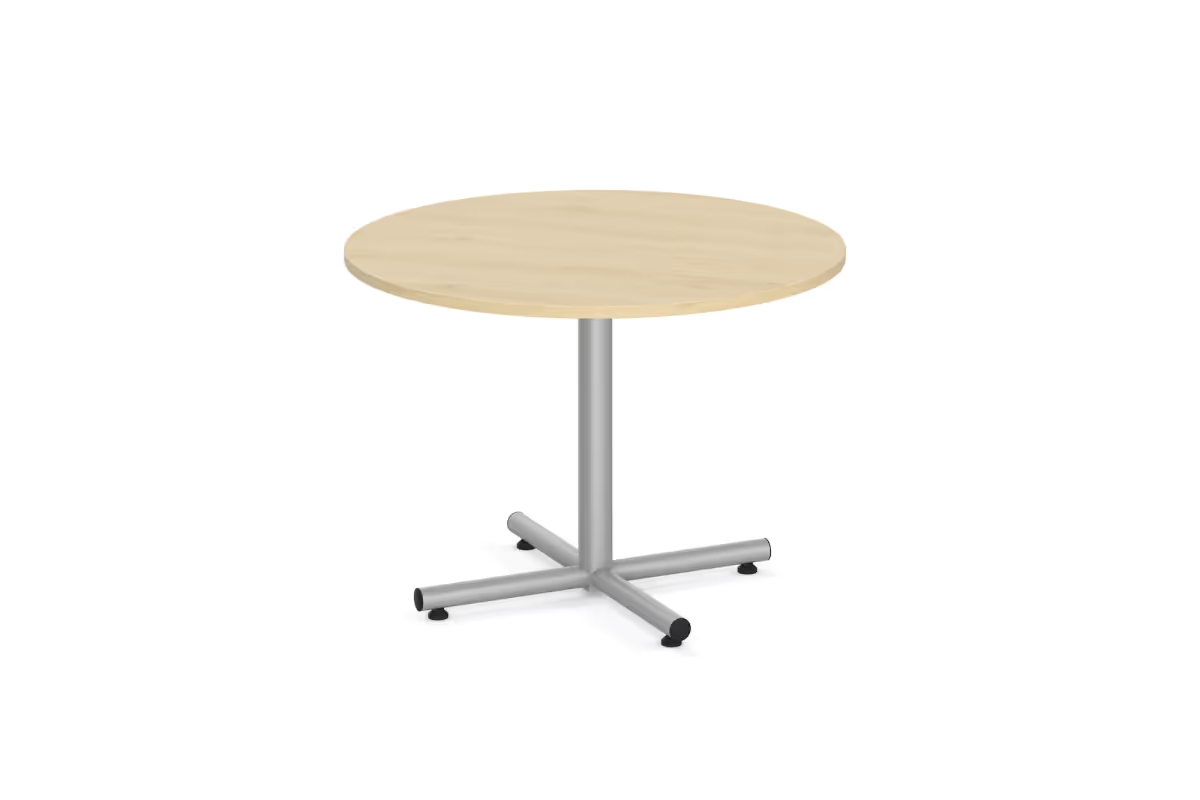
The Round Multi-Purpose Table with Standard Base is the most versatile option, appropriate for environments where consistent daily use across a variety of meeting types is expected and the priority is a stable, clean-profile table that works across contexts without drawing attention to itself. The Round Conference and Multi-Purpose Table with X Base adds a design-forward base profile appropriate for breakrooms, collaborative lounge areas, and smaller conference rooms where the table should contribute to the room's visual character. The Square Conference and Multi-Purpose Table with Brushed Aluminum Base suits compact rooms where a round footprint is less efficient than a square one and the brushed aluminum base coordinates with a modern or industrial office aesthetic.
Table shape affects how people interact around it. Round tables eliminate the head-of-table position that rectangular tables create, which means no participant is visually elevated above others by their seat position. This makes round tables particularly effective for collaborative discussions, brainstorming sessions, and small team meetings where equal participation is the goal. Square tables at smaller scales achieve a similar dynamic while using floor space more efficiently than a circle of equivalent seating capacity. Rectangular tables, by contrast, establish a natural hierarchy with the head positions carrying more visual authority, which makes them more appropriate for presentations and structured meetings than for open collaborative discussions.
A multi-purpose table in practice is a table that serves more than one functional role without requiring physical reconfiguration. A round table in a breakroom hosts lunch at midday and a team huddle in the afternoon. The same table in a small conference room serves a four-person meeting in the morning and a one-on-one client discussion later. The commercial-grade construction of the tables in this collection means they handle this daily variability in use without the wear that residential-grade tables show quickly under the same conditions. For offices that are managing space efficiently and cannot dedicate rooms to single functions, multi-purpose tables are a practical specification rather than a compromise.
The base design of a table affects both the room's visual character and its functional usability. A standard base provides a stable, low-profile foundation that works across aesthetic contexts without asserting a strong design identity. An X base keeps the floor visually open beneath the table, which makes smaller rooms feel less visually weighted at floor level and creates a more contemporary profile. A brushed aluminum base introduces a material character that reads as modern and refined, coordinating particularly well with environments that use metal accents, glass, and neutral surfaces as part of a broader design language. In smaller rooms, the base profile is often as visible as the tabletop itself, making base selection as important as surface material selection.
Three Configurations for Flexible Office Environments
The Round Multi-Purpose Table with Standard Base is the versatile workhorse of this collection. The round shape eliminates the head-of-table hierarchy that rectangular tables create, encouraging equal participation across every seat. The standard base provides a stable, clean-profile foundation appropriate for environments where the table will see consistent daily use across a variety of meeting types, from small team check-ins to informal client discussions.
The Round Conference and Multi-Purpose Table with X Base combines the round shape's collaborative advantage with an X base that adds a distinctive visual element to the room. The X base profile keeps the floor visually open beneath the table, which is particularly effective in smaller rooms where visual weight at floor level can make a space feel more confined than it is. This configuration works well in breakrooms, collaborative lounge areas, and smaller conference rooms where the table needs to read as designed rather than simply functional.
The Square Conference and Multi-Purpose Table with Brushed Aluminum Base introduces a modern geometric profile that works especially well in compact rooms where a round table's circular footprint is less efficient and a full rectangular conference table is too large. The square shape allows group seating on all four sides at smaller scales, and the brushed aluminum base adds a refined industrial character appropriate for technology, design, and creative professional environments.
The Case for Multi-Purpose Table Specification
Organizations that specify dedicated single-function furniture for every room frequently find that some rooms sit underutilized while others are overbooked. A multi-purpose table specification solves this problem by making rooms more functionally flexible without requiring additional furniture to serve different needs on different days. The tables in this collection are built to commercial-grade standards appropriate for sustained daily use across multiple functions, not residential-grade pieces that look acceptable initially but degrade quickly under professional use patterns.
Delivery and Installation Across Greater Boston
Office Gallery International serves businesses across Greater Boston, including Norwood, Beverly, Marlborough, Plymouth, Quincy, and Waltham, with delivery and professional installation managed as part of every order. Contact the team at 781-762-3733 or email info@officegallery.net to discuss your timeline and receive a delivery and installation quote.
Comprehensive Summary
- Space utilization research showing that most organizations use only 40 to 60 percent of their office space at any given time -- single-function rooms dedicated to one meeting type sit empty when that type of meeting is not scheduled; multi-purpose rooms furnished with flexible tables maintain higher utilization rates by serving different functions across the workday without physical reconfiguration
- The shift toward hybrid work increasing the variability of daily space requirements -- hybrid schedules mean the number of people using any given space varies significantly day to day; multi-purpose tables accommodate the smaller groups that show up on lower-attendance days as naturally as they accommodate the full groups that arrive on high-attendance days
- Breakrooms and collaborative areas serving dual functions as informal meeting space -- organizations that furnish breakrooms and collaborative areas with multi-purpose tables effectively expand their meeting capacity without adding dedicated conference rooms; the table that seats four for lunch serves the same four for an impromptu team discussion without anyone having to move to a different space
- Conference rooms that double as training rooms requiring tables that reconfigure or clear -- organizations whose conference rooms host training sessions, all-hands meetings, or events that require different seating arrangements benefit from tables that are sized and shaped for both configurations without requiring a full furniture change between uses
- Commercial-grade construction maintaining appearance and performance across multiple daily use contexts -- a multi-purpose table that deteriorates quickly under varied daily use defeats the flexibility it is intended to provide; the tables in this collection are built to commercial standards that sustain their appearance and structural integrity through the sustained varied use that multi-purpose specification requires
- Cost efficiency of fewer, more flexible pieces versus more, single-function pieces -- a multi-purpose table that serves three different functions in one room costs significantly less than three dedicated pieces of furniture for three dedicated rooms; the flexibility premium in well-specified multi-purpose furniture pays for itself in reduced total furniture investment and better space utilization
- Round tables eliminating hierarchy and improving sightlines for collaborative work -- the absence of a head position means every seat at a round table carries equal visual authority; in discussions where participation from all attendees is the goal, this equality in seating position encourages broader contribution rather than deference to whoever sits at the head
- Round tables creating a natural conversation geometry -- the circular arrangement of participants around a round table positions everyone facing slightly inward toward the center of the group rather than toward a defined front of the room; this geometry is more conducive to open discussion than the linear arrangement of participants along the sides of a rectangular table
- Square tables achieving similar collaborative dynamics at smaller scales with better floor efficiency -- a square table seating four people uses floor space more efficiently than a round table of equivalent seating capacity; in compact rooms where floor area is the constraint, the square table delivers the collaborative seating dynamic of a round table within a smaller footprint
- Square tables allowing grouping for larger configurations -- multiple square tables can be pushed together to form larger rectangular or extended square configurations for training or all-hands setups; this grouping flexibility is not available with round tables, making square tables a more versatile choice for rooms that need to shift between small-group and large-group configurations
- Round tables working better in rooms with more floor area -- the circular footprint of a round table becomes more space-efficient relative to seating capacity at larger sizes; in rooms with adequate floor area, a round table seats a group more compactly than an equivalent rectangular table because it eliminates the dead space at the corners of a rectangle where no one sits
- Base design affecting the visual weight of the table relative to room size -- in smaller rooms, a base that keeps the floor visually open beneath the table makes the space feel less confined; the X base and brushed aluminum base configurations in this collection both achieve this effect through their open base geometries, which is a meaningful specification consideration for rooms where floor area is limited
- Room dimensions determining table size and shape appropriateness -- the table must fit within the room with adequate clearance for chairs to pull out and participants to move around the perimeter; 36 to 48 inches of clearance from table edge to wall is the standard requirement, and this clearance must be confirmed against the actual room dimensions before a table size is selected
- Ceiling height affecting the visual balance of the base profile -- rooms with lower ceilings benefit from tables whose base profiles keep the visual mass close to the floor; rooms with higher ceilings can accommodate bases with more vertical presence without making the room feel top-heavy
- Flooring material and finish coordinating with table base material -- a brushed aluminum base reads differently against polished concrete than against carpet or hardwood; confirming that the table base material coordinates with the room's existing flooring prevents the visual mismatch that arises when furniture and room finishes are specified independently
- Adjacent furniture establishing the aesthetic register the table needs to match -- a square table with brushed aluminum base placed in a room furnished with warm wood tones and fabric upholstery creates a visual tension that a round table with a standard base in the same finish family would not; the multi-purpose table specification should account for the aesthetic context of the room it occupies
- Lighting position relative to table placement affecting surface appearance -- overhead pendant lighting centered over a round table creates an intentional focal point that can anchor a room's visual composition; the same lighting off-center over a table creates visual imbalance; confirming lighting positions relative to the planned table placement before installation prevents this
- Traffic flow paths around the table accounting for door swing and room entry -- a table positioned too close to the door creates the physical awkwardness of participants having to navigate around the table immediately upon entering the room; ensuring adequate clearance between the table and the primary entry path is a placement requirement that affects every interaction in the room
- Breakroom tables requiring durability specifications appropriate for food and beverage contact -- multi-purpose tables placed in breakrooms are exposed to food spills, coffee rings, cleaning chemicals, and daily wiping that office conference tables are not; surface materials specified for breakroom use should be non-porous and resistant to the cleaning products used in food service environments
- Round tables in breakrooms encouraging social interaction rather than task orientation -- the round shape in a breakroom setting signals that the table is a social space rather than a work space, which psychologically invites the kind of informal conversation that supports the rest and recovery function that breakrooms serve; a rectangular table in a breakroom can inadvertently signal a work context that reduces its effectiveness as a decompression environment
- Breakroom table height affecting the nature of interaction -- standard height tables at 29 to 30 inches support seated meals and conversation; café height tables at 36 to 42 inches encourage shorter, more casual interactions appropriate for quick breaks; the multi-purpose tables in this collection are standard height, appropriate for seated use across both meal and meeting functions
- Collaborative area tables benefiting from bases that do not obstruct leg movement -- in casual collaborative areas where participants frequently shift position, cross their legs, or sit informally, table bases that extend across the floor area beneath the table create physical awkwardness; the X base and brushed aluminum base configurations in this collection are designed to minimize this obstruction while maintaining structural stability
- Table size in collaborative areas balancing seating capacity with spatial openness -- a collaborative area table should seat the typical small-group size without overwhelming the space with a table footprint that leaves insufficient room for the casual movement that collaborative work involves; specifying the smallest table that adequately seats the typical group size preserves the spatial openness that makes collaborative areas feel inviting rather than confined
- Office Gallery's space planning support available for collaborative area layout questions -- the team can assist with table size selection, placement, and coordination with adjacent seating and storage to ensure the collaborative area functions as intended; contact the team at 781-762-3733 or visit the showroom at 151 Carnegie Row in Norwood to discuss your specific space
- Standard base as the reliable, aesthetically neutral foundation -- the standard base provides stability and a clean profile without asserting a strong design identity; it is the appropriate specification when the table needs to function well across multiple aesthetic contexts or when the room's design language is still evolving and a neutral base reduces the risk of future mismatch
- X base as the design-forward option that keeps the floor visually open -- the X base crosses beneath the table surface in an open geometric pattern that keeps sight of the floor visible from seating height; this visual openness makes smaller rooms feel less visually weighted at floor level, which is a meaningful specification advantage in compact collaborative areas and breakrooms
- Brushed aluminum base as the modern material character option -- the brushed aluminum finish introduces a specific material quality that reads as contemporary and refined; it coordinates particularly well with environments that use metal accents, glass surfaces, concrete flooring, and the neutral palettes that modern office design favors
- Base stability as a non-negotiable specification requirement across all types -- a table base that wobbles or flexes under the weight of participants leaning on the surface creates physical discomfort and communicates poor quality; all three base configurations in this collection are built to commercial-grade stability standards appropriate for sustained daily use across multiple participants
- Base footprint affecting the clearance available for leg movement beneath the table -- participants seated at a table need adequate leg clearance beneath the surface; bases with large footprints that extend significantly toward the seating positions create physical awkwardness; the base designs in this collection are selected for the balance between stability and clearance that seated daily use requires
- Visual coordination between base material and surface finish -- a brushed aluminum base coordinates most naturally with surfaces in lighter neutral tones, glass, or contemporary wood grain finishes; a standard base or X base in powder-coated finishes offers more flexibility across surface finish types; the Office Gallery team can assist with surface and base combination selection to ensure the finished table reads as a coordinated piece rather than a mismatch
- Contact Office Gallery International first to confirm current availability -- the Quick Turnaround designation reflects availability at the time the collection was curated; current availability and lead times are confirmed through direct contact with the team at 781-762-3733 or info@officegallery.net rather than assumed from the product listing
- Room dimensions and intended use provided before the specification conversation -- knowing the room's dimensions and the primary functions the table needs to serve enables the Office Gallery team to recommend the most appropriate shape, size, and base configuration rather than defaulting to a generic recommendation
- Showroom visit enabling in-person evaluation of base profiles and surface finishes -- the visual and physical quality of table bases and surface finishes are assessments that product photography does not fully convey; visiting the showroom at 151 Carnegie Row in Norwood before ordering enables a confident selection based on actual material and finish evaluation
- Space planning support available for multi-table configurations -- organizations furnishing multiple areas with multi-purpose tables simultaneously benefit from space planning support that confirms table sizes and placements work together across the office rather than creating inconsistencies between rooms
- Delivery and installation coordinated as part of every order -- the team manages delivery scheduling, building access logistics, and professional installation so that tables arrive positioned and ready for use; for multi-table orders, installation is coordinated as a single visit rather than requiring separate scheduling for each piece
- Post-installation support available through the Office Gallery relationship -- warranty coordination, reconfiguration assistance, and future additions are handled through the same team that managed the original order; the relationship does not end at delivery for the full life of the furniture


