3 Signs Your Office Is Actively Pushing People Toward Remote Work
Office noise can cut productivity by up to 66%, and a poorly utilized desk can waste over $5,500 a year. Here are the three conditions, unmanaged noise, exclusionary hybrid meetings, and no team space, quietly pushing employees toward remote work, along with the specific fixes for each.
Post Summary
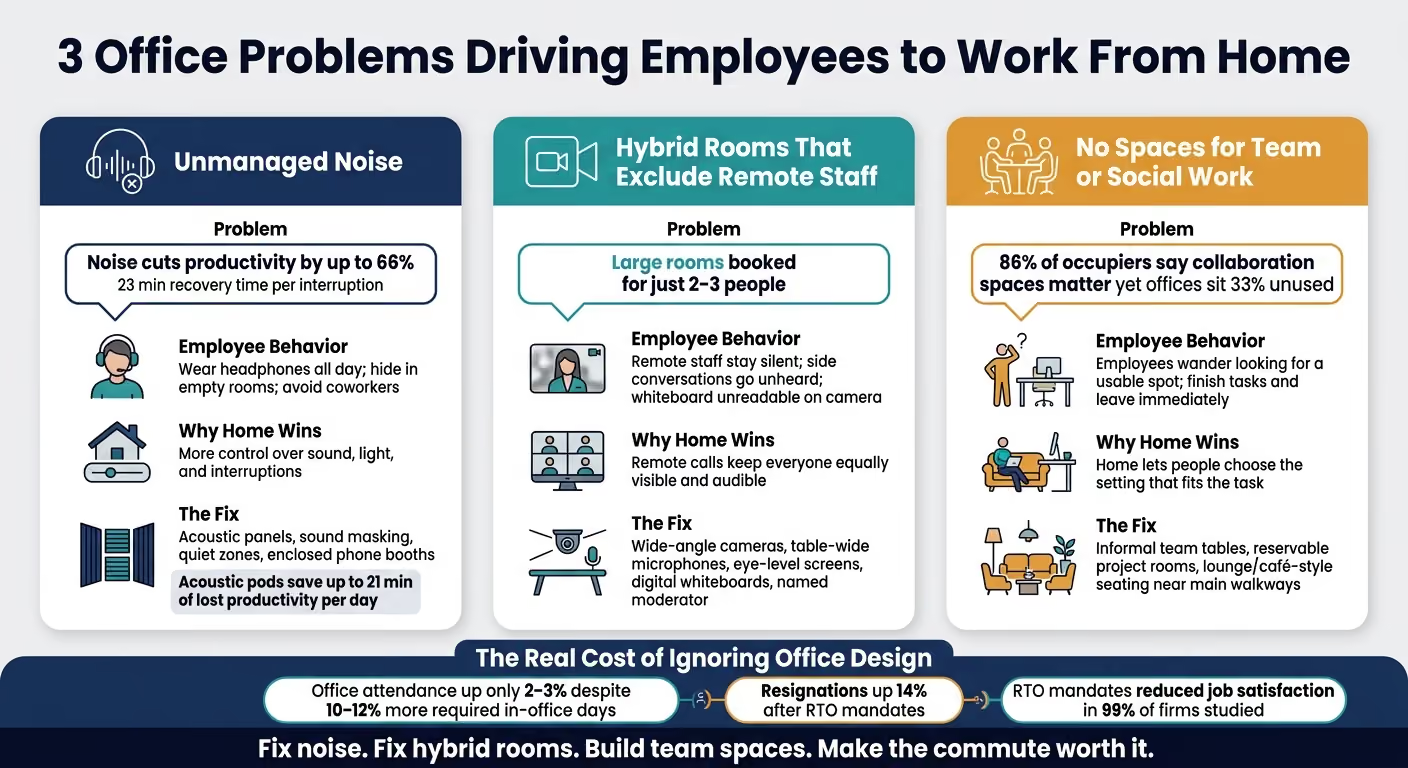
Office noise carries a measurable productivity cost, not just an annoyance factor. Research shows a single interruption in an open office can cost 23 minutes of recovery time, and unmanaged noise can cut overall productivity by as much as 66 percent. That cost compounds throughout the day as employees get pulled out of focused work repeatedly, then need extended time to fully re-engage each time. The behavioral response makes the problem visible: employees wearing headphones continuously, hopping between empty conference rooms to find quiet, or avoiding casual conversation altogether to protect the focus they have left. None of that reflects an office working as intended. A layered acoustic plan, panels, sound masking, quiet zones, and enclosed pods, addresses the noise directly rather than asking employees to manage around it.
A desk running at only 35 percent utilization can waste more than $5,500 a year in real cost. That figure reflects rent along with the operating expenses, HVAC, cleaning, and maintenance, that continue regardless of whether the desk is actually used. Multiplied across dozens or hundreds of desks, an underutilized floor can represent a significant, ongoing drain that never shows up as a single line item leadership notices. This is why utilization data matters as much as attendance data. A desk can appear "occupied" on a lease document while sitting empty most working days, and that gap between paper capacity and real use is exactly where wasted spend accumulates year over year.
Open-plan conversions can cut face-to-face interaction by as much as 70 percent, the opposite of what most organizations expect when they remove walls. Instead of collaborating more, employees shift into self-protection mode: wearing headphones, avoiding casual conversation, and guarding the limited focus they have left in a loud environment. The intended benefit of an open layout, more spontaneous interaction, gets undermined by the very noise and lack of privacy the layout creates. That's why an open floor plan alone isn't a collaboration strategy. Without acoustic management and dedicated zones for different types of work, an open office can actively discourage the interaction it was designed to increase.
A functional hybrid meeting room needs four things working together: a wide-angle camera positioned so every seat is visible on screen, microphones spread across the table rather than clustered in one spot, an eye-level display so in-room participants look directly at remote coworkers, and power access at every seat. Equipment alone isn't enough. Meeting behavior matters just as much, using a digital whiteboard instead of a physical one, having a moderator call on remote attendees by name, and keeping side conversations audible to the whole group. Rooms that skip either the equipment or the behavioral rules tend to leave remote participants repeating themselves or disengaging from the conversation entirely.
When an office has desks but no genuine spaces for team or social interaction, there's little reason to stay once individual tasks are done. Data shows 86 percent of occupiers say collaboration spaces matter to their organization, yet offices still sit roughly 33 percent unused because many layouts don't match how teams actually work day to day. Without informal collaboration zones, reservable project rooms, or lounge-style seating, casual interaction has nowhere to happen, so employees default to a transactional pattern: arrive, work, leave. That pattern undercuts one of the strongest arguments for coming into the office in the first place, the relationships and spontaneous problem-solving that don't happen over video calls.
If your office is loud, awkward for hybrid meetings, and short on team space, people will keep choosing home.
We’d sum it up like this: RTO rules don’t fix a bad office setup. The article points to three plain problems that push people away from the office: too much noise, meeting rooms that shut out remote staff, and layouts with no good place to meet or work together. It also shows the cost: office attendance only moved up 2% to 3% in 2026 even as required in-office days went up 10% to 12%, and resignations went up 14% after RTO mandates.
Here’s the short version:
- Noise kills focus: office noise can cut productivity by up to 66%, and one interruption can cost 23 minutes of recovery time.
- Bad hybrid rooms waste the commute: if remote people can’t hear, see, or join in, the room fails both in-office and remote staff.
- No team space means no reason to stay: when the office has desks but not good group areas, people finish work and leave.
What we take from this: fix sound, fix meeting rooms, and add spaces for focus, calls, and group work. If you don’t, home keeps winning.
Quick Comparison
Bottom line: if the office makes work harder, people notice fast. This piece explains the three signs to watch for and the fixes that can make coming in feel worth it.
Why Employees Compare the Office to Home
Every day, employees are asking a simple question: Is coming in worth it? The answer usually comes down to one thing. Can the office help them get work done with less friction than home?
People size up the office the moment they sit down. Can they focus without getting knocked off track? Will anyone hear them clearly in a hybrid meeting? Is there a place for a private conversation that doesn’t turn into a broadcast for the whole floor? If the answer keeps being “no,” the trip in starts to feel like a bad trade.
That friction often starts with noise. In an open office, a single interruption can lead to 23 minutes of recovery time, and office noise can cut productivity by as much as 66% [1].
That’s why offices need quiet zones alongside team spaces. Without them, people lose focus, privacy, and patience. At home, employees usually have more control over noise, light, and interruptions. When the office makes work feel harder instead of easier, people stay home.
The first sign is unmanaged noise.
1. Noise Without Acoustic Management
Walk through most open offices and you’ll spot the same pattern: employees wearing headphones, heads down, trying to tune out the room. Some hop between empty conference rooms just to find a quiet place for a call. Others keep their distance from coworkers because in a noisy office, even a short chat can wreck their focus.
Research backs that up. Open-plan conversions can cut face-to-face interaction by 70% [1]. That’s the exact opposite of what many organizations expect when they knock down walls. People don’t start working together more. They start guarding the focus they still have. That’s a big reason home can feel easier to work in.
There’s a clear cost to that behavior too. At 35% utilization, a desk can waste up to $5,525 per year [2].
The answer isn’t a full remodel. It’s a layered acoustic plan that deals with noise from a few angles at once:
- Fabric-wrapped panels and ceiling baffles to absorb echo
- A sound masking system to make distant conversations less clear
- Quiet zones with rules people are expected to follow
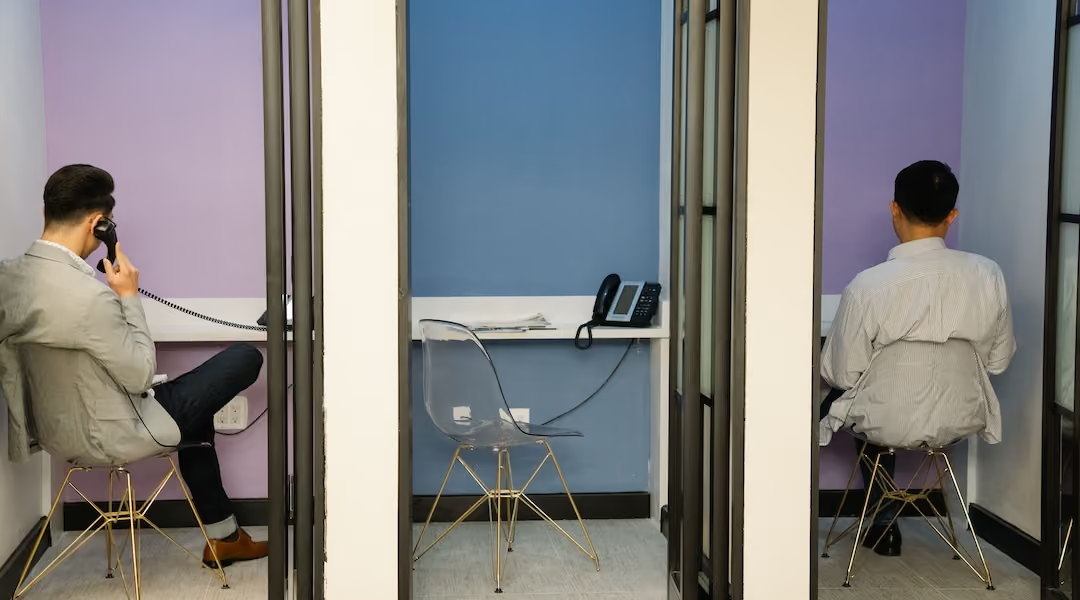
- Enclosed acoustic pods or phone booths for private calls and deep-focus work
That last piece can make the biggest difference. Acoustic pods and phone booths remove the hunt for quiet space and can save employees up to 21 minutes of lost productivity per day [6].
A June 2026 example from Bridgewater, MA shows how this can work in practice. A firm there cut distractions from simultaneous client calls by adding acoustic panels. The panels absorbed sound and reduced distractions without closing off the floor plan [1].
Once noise pushes people into self-protection mode, the next problem shows up fast: a meeting room that still leaves remote participants out.
2. Hybrid Meeting Rooms That Leave Remote Participants Out
Even when people do come in, a bad hybrid room can make the whole office feel broken. Someone on the call says, "Sorry, can you say that again?" Then again. Then a third time. At the same time, the people in the room are already three topics ahead, reacting to a side conversation no one on the call could hear or a whiteboard no remote attendee can read. Most hybrid meeting problems come down to three things: room layout, audio, and meeting behavior. [1]
Long tables are a common culprit. The camera often lands on one person in the middle while everyone else fades into the background. That makes it harder for remote participants to pick up on facial expressions, reactions, and other visual signals that help them follow the discussion and stay involved. [1]
The fix isn't just swapping in a better camera. The room itself has to work for hybrid meetings. That means wide-angle cameras set up so every seat shows up on screen, microphones spread across the table so each speaker comes through clearly, and eye-level displays that let people in the room look at remote coworkers directly instead of off to the side. [1] If the office already feels loud or distracting, a poor hybrid setup only drives home the point that the commute wasn't worth it.
Behavior matters just as much as the gear. Without clear meeting rules, people in the room will almost always take over. A few simple habits can close that gap:
- Use a digital whiteboard instead of a physical one
- Have a moderator call on remote attendees by name
- Make sure side conversations happen where everyone can hear them
Those small changes help fix what furniture and equipment can't solve on their own. [1]
That's the second sign. The third is an office with nowhere built for real social or team work.
3. No Spaces Built for Social or Team Work
Even when hybrid meetings run fine, the office can still lose people if there’s nowhere to work together after the meeting ends. If employees come in, finish their tasks, and head out, the office starts to feel like a job site, not a place people want to spend time in. And when there are no spots built for collaboration, there’s little reason to stay once the work is done.
This gap shows up in the data. 86% of occupiers say collaboration spaces matter, yet offices still sit about 33% unused because many layouts don’t match the way teams work day to day [2]. That kind of mismatch changes habits fast. People wrap up what they need to do, then go home. At that point, the office loses its argument for the commute.
Without team areas, casual conversation can feel like a distraction instead of something useful. The better move is a connected mix of spaces:
- Informal collaboration zones with team tables and writable surfaces
- Reservable project rooms for focused group work
- Lounge or café-style seating that makes it easier to stay, talk, and connect
Placement matters too. Social areas should sit near main walkways so people naturally pass through them. But they also need some separation from quiet zones, using acoustic screens or partitions to keep noise from spilling over.
Quick Diagnostic Table: Condition, Behavior, Remote Advantage, Fix
Use this table to size up the friction, the edge remote work has, and the fix.
Conclusion
An RTO mandate isn't a design strategy.
You can require badge scans, set attendance targets, and track presence all day long. But that won't fix a floor plan that's too loud for focused work, hybrid meeting rooms that leave remote coworkers out, or an office layout with nowhere to work together. Employees judge the office itself. And the effect shows up in the data.
A study of 137 S&P 500 firms found that RTO mandates did not improve performance or firm value, but they did reduce job satisfaction in 99% of firms. [4] That's not a compliance issue. It's a design issue.
So the floor plan matters more than the badge count. Look at what people are doing in the space. Are they wearing headphones all day? Are two people taking over large conference rooms? Are employees pacing the floor trying to find a quiet place to work? Usage data turns office friction into facts leaders can use.
Control noise. Make hybrid meetings fair. Build spaces that give people a reason to commute. Fix those three conditions, and the commute stops feeling like a penalty.
FAQs
How can I tell if noise is the main reason people avoid the office?
Start with a noise audit and ask employees directly where distractions hit hardest and how those distractions affect each team. If attendance data shows that people stay home when they need to focus, noise may be a big reason why.
You can spot the same issue in other ways too. Maybe productivity drops after interruptions. Maybe employees lean on digital tools just to escape a loud office. When that pattern shows up, your space likely needs better acoustic support and quiet zones.
What makes a hybrid meeting room actually work?
A hybrid meeting room works when people in the office and people joining remotely get a similar experience. In plain English, that means the room needs a wide-angle camera, a clear display for remote teammates, table-wide audio pickup, and power access at every seat.
It also needs acoustic treatment to cut background noise and keep meeting audio from spilling into nearby work areas. And the furniture should be modular, so the room can shift with different group sizes.
Which office fixes should leaders prioritize first?
Prioritize the friction point that’s causing the biggest productivity loss.
- If noise is the main complaint, start with acoustic treatment.
- If hybrid meetings are the issue, improve camera placement, displays, and audio pickup.
- If connection is lacking, add break rooms or lounge areas to support informal interaction.
•••••
The right workplace design measurably improves employee performance, satisfaction, and retention. Office Gallery partners with businesses on that strategy, and welcomes architects and interior designers looking for a furniture and space-planning partner on their own projects. Contact the team at 781-762-3733, email info@officegallery.net, or visit the showroom at 151 Carnegie Row in Norwood.
Key Points
What are the warning signs an office is pushing employees toward remote work?
- Headphone culture: Employees wearing headphones continuously or hopping between empty conference rooms signals unmanaged noise is disrupting focus.1
- Empty collaboration space: Areas built for team work sitting consistently unused points to a layout mismatch rather than a lack of need for collaboration.2
- Hybrid meeting friction: Remote employees repeating themselves or going quiet on calls signals the meeting room equipment and format aren't working.1
- Declining face-to-face interaction: A drop in spontaneous conversation after an open-plan conversion, rather than the expected increase, is a measurable red flag.1
- Low desk utilization: Desks running well below capacity despite steady headcount often means the space itself, not attendance policy, is the problem.2
- Attendance without engagement: People showing up to satisfy a mandate but leaving immediately after individual tasks are done reflects a space that isn't earning the commute.
How does acoustic treatment address office noise problems?
- Panels and baffles: Fabric-wrapped panels and ceiling baffles absorb echo and reduce ambient noise across open layouts.
- Sound masking: A sound masking system makes distant conversations less intelligible, reducing the pull of nearby distractions.
- Quiet zones: Designated quiet areas with clear behavioral expectations give employees a reliable place to do focused work.
- Acoustic pods: Enclosed phone booths and pods remove the need to hunt for quiet space and can save employees up to 21 minutes of lost productivity per day.6
- Layered approach: Combining multiple acoustic strategies addresses noise from several angles at once rather than relying on a single fix.
- Measurable impact: A layered acoustic plan directly counters the productivity loss tied to unmanaged noise, which can run as high as 66 percent.1
What meeting room mistakes exclude remote participants?
- Long conference tables: A long table often puts the camera on one person while everyone else fades into the background, cutting off visual cues for remote attendees.1
- Single fixed camera: A standard, non-wide-angle camera fails to capture every seat, leaving some in-room participants effectively invisible.
- Centralized audio: Microphones clustered in one spot make speakers on the far side of the table difficult for remote attendees to hear clearly.
- Physical-only whiteboards: A physical whiteboard that isn't mirrored digitally leaves remote participants unable to follow visual discussion.
- No moderation: Without a moderator calling on remote attendees by name, in-room participants tend to dominate the conversation by default.1
- Side conversations: Side discussions that happen off-mic exclude remote participants from context the rest of the room has access to.
What does a connected mix of collaboration spaces look like?
- Informal collaboration zones: Team tables and writable surfaces support quick, unplanned group work without requiring a reserved room.
- Reservable project rooms: Bookable rooms give teams a dedicated space for focused group work on a specific project or deadline.
- Lounge or cafe-style seating: Casual seating areas make it easier for employees to stay, talk, and connect after formal work is done.
- Proximity to walkways: Social spaces placed near main walkways see more natural, organic use than spaces tucked out of the way.
- Acoustic separation: Screens or partitions between social zones and quiet zones keep casual noise from disrupting focused work nearby.
- Match to actual team behavior: Layouts should reflect how teams actually work day to day, not a generic collaboration template, since mismatched layouts are a major driver of unused space.2
What data should leaders track to confirm employees are avoiding the office?
- Desk utilization rate: Persistent utilization well below capacity, especially near or below 35 percent, is a strong signal the space itself is a factor.2
- Room booking versus actual use: A gap between how often rooms are reserved and how often they're actually occupied often points to layout or equipment problems.
- Attendance versus mandate gap: A small increase in actual attendance despite a larger increase in required in-office days signals the office itself isn't earning the commute.
- Post-RTO resignation trends: A rise in resignations following a return-to-office mandate is a direct signal that the mandate is addressing compliance, not the underlying friction.
- Employee-reported noise complaints: Direct feedback on where and when distractions hit hardest can pinpoint specific zones needing acoustic treatment.
- Job satisfaction shifts post-mandate: Broader research found RTO mandates reduced job satisfaction in 99 percent of firms studied without improving performance or firm value, underscoring why data, not mandates, should drive space decisions.4
What happened when a Bridgewater, MA firm addressed office noise directly?
- Starting problem: Simultaneous client calls were creating significant distraction across the floor before any acoustic intervention.
- Fix applied: The firm added acoustic panels rather than pursuing a full remodel or closing off the floor plan.
- Sound absorption: The panels absorbed sound directly at the source, reducing how far distracting noise traveled across the space.
- Open layout preserved: The fix worked without sacrificing the open floor plan, avoiding the cost and disruption of permanent construction.1
- Timing: The example dates to June 2026, making it a recent, current reference point rather than a dated case study.
- Takeaway for other offices: The case shows a targeted acoustic fix can meaningfully reduce noise-driven distraction without a full office redesign.