Return to Office Is Failing - and the Office Is Usually to Blame
Office attendance is stuck at 54% of pre-2020 levels, and 41% of employees say a stricter mandate would send them job hunting. The real failure point is not policy. It is an office built for a version of work that no longer exists, and the fix starts with acoustics, ergonomics, and reliable hybrid technology.
Post Summary
Office attendance has plateaued at roughly 54% of pre-2020 levels even as employers ask for an average of 3.2 in-office days per week against an employee average of 2.9. Only 44% of workers said they would follow a strict five-day mandate, 41% said they would start looking for a new job, and 14% said they would quit outright, and stricter mandates raise resignation risk by 14%. The underlying issue is that home now outperforms the average office on 17 of 21 work activities, largely because 58% of workers have built a dedicated home office. When the workplace offers fewer functional advantages than a spare bedroom, no attendance policy fixes that gap. The office itself has to close it.
Open-plan offices commonly measure 60 to 65 decibels, well above the 40 to 55 decibel range considered ideal for focused work. A single interruption costs an average of 23 minutes and 15 seconds of recovery time, and in a large field study 99% of employees said office noise hurt their concentration. Speech is the hardest noise to filter out because the brain keeps trying to parse the words, which makes nearby phone calls and side conversations more disruptive than mechanical sound. When an open floor plan forces heads-down work and casual conversation into the same space, concentration becomes structurally difficult. Enclosed quiet rooms, phone booths, acoustic ceiling treatment, and floor plans that separate focus zones from group zones are the direct fix, and none of it requires a full remodel.
Many employees upgraded their home setups during the remote work years with better chairs, monitor arms, and sit-stand desks, so returning to a fixed desk and a basic task chair often feels like a step backward. A 1-centimeter deviation from correct working height increases muscle fatigue by 10% to 15% over an eight-hour day, and office workers spend roughly 1,700 hours a year in their chairs, so outdated seating compounds into real physical strain. Height-adjustable desks can reduce neck and back pain by 54% when they cut sitting time by just 66 minutes a day, and ergonomic upgrades overall have been linked to a 40% productivity increase in controlled workplace studies. When the office chair causes discomfort before the afternoon ends and the home setup does not, the commute stops feeling like a reasonable trade.
Meeting rooms are one of the most common breaking points in a return-to-office plan. Industry data shows 77% of workers have lost time to technical difficulties in meeting spaces, the average employee spends over six minutes just getting a meeting started, and 67% have abandoned video entirely after failing to get the room's technology working. Audio is the biggest factor, with 81% of professionals ranking it as the top video-conferencing variable, and research shows poor call audio damages listeners' judgment of the speaker, not just their understanding of what was said. That combination of wasted time and reputational risk gives employees a rational reason to take an important call from home instead of a conference room that might fail mid-meeting. The fix starts with microphone arrays and even speaker coverage rather than camera upgrades.
Many offices were designed around assigned desks and fixed connections, then shifted to hot-desking without upgrading the power, Wi-Fi, and display access that flexible seating actually requires. The result: 63% of hybrid employees run into tech problems on the days they come into the office, and the average hybrid worker needs at least 25 minutes just to get connected and settled, nearly half an hour lost before the workday starts. Slow office networks are the top connectivity complaint for 37% of employees, and 29% report office Wi-Fi as a problem outright. Huddle rooms compound the issue, since roughly half of employees say small meeting rooms lack basic collaboration tools and only about 3% are properly equipped. When people cannot plug in, share a screen, or stay connected from the seat they are using, the office loses to home on basic functionality before any work begins.
Many people skip office days because the office often works worse than home. If you want people back, the fix is usually not more pressure. It’s a quieter space, better chairs and desks, working meeting rooms, and power and Wi‑Fi that don’t waste time.
The core points:
- Office use is still low at about 54% of pre-2020 levels
- Companies want 3.2 days in office, but workers average 2.9 days
- Only 44% said they would follow a 5-day office rule
- 41% said they’d look for a new job, and 14% said they’d quit
- Home now beats the average office for 17 of 21 work activities
- 58% of workers now have a dedicated room or office at home
- Open offices often hit 60–65 dB, which is too loud for focus
- 63% of hybrid staff hit tech problems when they come in
- Bad meeting-room audio, weak Wi‑Fi, and poor desk setup make office days feel like a step back
What we take from this is simple: people are not rejecting work. They’re rejecting friction. When the office is noisy, uncomfortable, and hard to use, home wins.
Our main fix is also simple:
- Split space into focus zones, call booths, and team areas
- Upgrade ergonomic seating, height-adjustable desks, and acoustics
- Fix meeting-room audio/video
- Put power, displays, and Wi‑Fi where people actually sit
Net-net: a return-to-office plan fails when the office gives people fewer ways to do good work than home does.
So if you’re asking why return to office keeps falling short, our read is: the office often isn’t built for the way people work now.

The data: return to office is still falling short
Office attendance has plateaued below pre-2020 levels
Office attendance has leveled off, but it's still below where it was before 2020. That makes office design a tougher issue. If people are going to commute, the office has to feel worth the trip.
Right now, employers want an average of 3.2 in-office days per week, while employees are averaging 2.9 [1]. That may look like a small gap, but across teams and across weeks, it adds up fast. And if companies push harder without fixing the workplace itself, the risk climbs: stricter mandates increase resignation risk by 14% [1].
So the main problem isn't just getting people through the door. It's what they find once they get there.
Most employees still prefer hybrid over full-time office work
Employees aren't resisting full-time office work for vague reasons. The pain points are pretty concrete: commute time, noise, lack of privacy, and poor meeting quality.
When the office doesn't beat home for focused work or basic comfort, the trade-off feels lopsided. The commute starts to feel like a tax, not a gain.
Comparison table: what leaders expect vs. what employees experience
There's a clear gap between what leaders want the office to do and what employees say it actually feels like. That gap shows up again and again in survey data.
That mismatch often comes down to the basics. Noise. Privacy. Ergonomics. And the kind of infrastructure people notice most when it fails.
Return to Office: Why It’s Failing (and What HR Isn’t Saying Out Loud)
Why the office itself drives employees back to remote work
The issue is design, not attitude. When the office is noisy, uncomfortable, and built around old layouts, it can work against people instead of helping them. The clearest proof shows up in day-to-day use: noise, ergonomics, and plain usability.
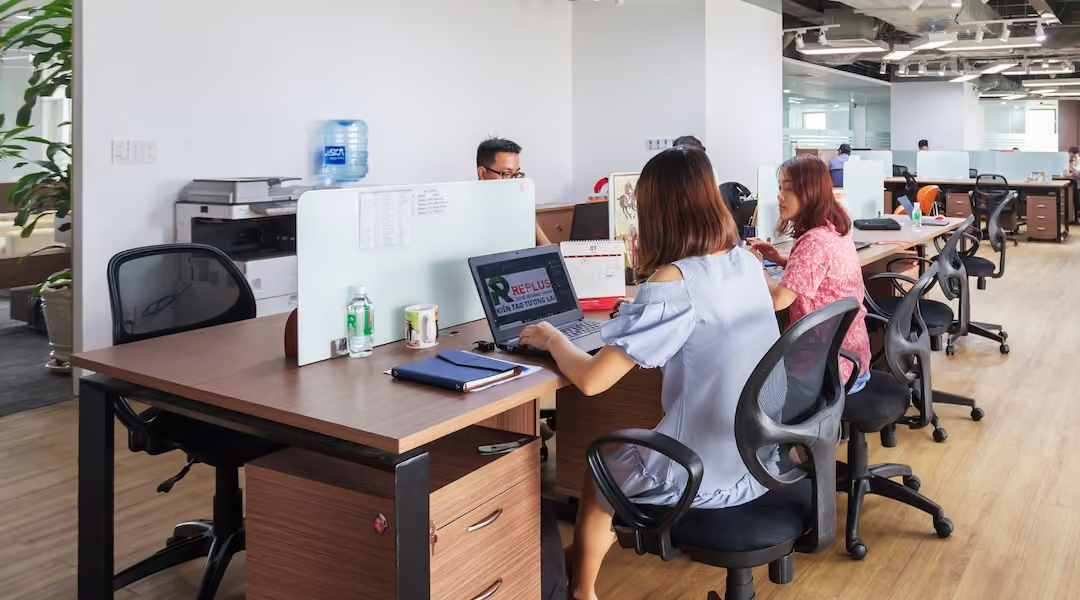
Open-plan noise and lack of privacy hurt focused work
Open-plan offices often measure 60–65 dB, which is well above the 40–55 dB range seen as best for focused office work. [7][11] That gap matters. Extra noise doesn't just get on people's nerves - it drains mental energy. Research shows it takes 23 minutes and 15 seconds to get back into a task after one interruption. [10][12] In a typical open office, people aren't dealing with just one.
The hardest noise to ignore isn't mechanical. It's people talking. Nearby phone calls, side conversations, and half-heard speech are tough to tune out because the brain keeps trying to make sense of words. [6][9] In a large field study, 99% of employees said office noise hurt their concentration. [11] That's not a people problem. It's a space problem.
What helps? Better planning, such as:
- Enclosed quiet rooms
- Phone booths
- Acoustic ceiling treatments
- Floor plans that separate heads-down work from group work
Even if people can concentrate, the office still needs to feel comfortable to sit in for hours.
Poor ergonomics make the office feel like a step down from home
During the remote work years, many employees improved their home setups with better chairs, monitor arms, and sit-stand desks. Going back to a fixed desk and a basic task chair can feel like a downgrade, and the data backs that up.
Small setup errors add up. A 1-centimeter deviation from the correct working height increases muscle fatigue by 10% to 15% over an eight-hour workday. [4] Office workers also spend about 1,700 hours per year in their chairs, [4] so old seating isn't a minor annoyance. It builds into physical strain over time.
That gap in ergonomics helps explain why remote work feels easier to keep up with. If the office chair starts hurting by midafternoon and the home setup doesn't, the commute can feel like a bad trade.
When a workspace makes it harder to focus and stay comfortable, employee pushback is a response to design, not mindset.
Comparison table: legacy office setup vs. typical home office
The next issue isn't just comfort. It's whether the office can handle hybrid work at all.
Technology and infrastructure gaps make office days less productive
Even a nice office setup falls apart when the tech is slow, flaky, or a pain to use. According to a 2025 Logitech study, 63% of hybrid employees run into tech problems on the days they come into the office, and the average hybrid worker needs at least 25 minutes just to get settled after arriving - connecting to Wi-Fi and getting their devices up and running [16]. That’s close to half an hour gone before the day even gets moving.
And that’s the bigger issue. Hybrid work leans on office systems that many companies still haven’t built out well enough.
Hybrid meeting rooms often fail on audio, video, and ease of use
A lot of meeting rooms still turn simple calls into mini repair jobs. Bad microphone placement, echo, spotty camera coverage, screen-sharing glitches, and too many steps to join all chip away at time and focus. Owl Labs’ State of Hybrid Work data found that 77% of workers have lost time to technical difficulties, the average employee spends over six minutes just starting a meeting, and 67% have given up trying to get meeting tech working in a room and simply abandoned video [13].
Audio is the big one. 81% of professionals rank it as the top video-conferencing factor, and weak sound hurts both understanding and how a speaker comes across [18]. A Yale study found that poor audio quality in video calls negatively affects listeners' judgments of the speaker, not just comprehension, which means bad room audio carries a reputational cost as well as a productivity one [17]. That helps explain a common pattern: when employees see an important client call or internal review on the calendar, many choose to take it from home, where the setup feels familiar and dependable.
The same kind of friction shows up outside conference rooms too.
Power, Wi-Fi, and display access are missing where people actually sit
Many offices were built for assigned desks and fixed connections. Then companies moved to hot-desking and flexible seating, but the wiring, power, and display access didn’t move with them. As a result, people end up in spaces that look ready for work but don’t quite support it.
CCS Insight found that slow office networks are the top connectivity problem for 37% of employees, and 29% say office Wi-Fi is a problem [15]. Display access is another weak spot. Jabra’s global data on huddle rooms found that 50% of employees report that small rooms lack basic collaboration tools, and only about 3% of huddle rooms are properly equipped [14]. If people can’t plug in, share a screen, or stay connected from the seat they’re using, the office starts to feel less workable than home. The fix isn’t to patch one room at a time. It means building the tech into the workspace itself.
Design fixes that can make the office worth the commute
Most of these fixes can be rolled out in phases with modular upgrades and very little downtime. The answer isn't a tougher return-to-office policy. It's a better layout.
Rezone the office for focus, collaboration, and hybrid work
The biggest change is simple: stop mixing quiet work with group work. Quiet work, collaboration, and calls should happen in different zones.
Research on activity-based workplaces found that moving employees from noisy open areas to designated quiet zones improved cognitive performance by 16.9%, while moving them to individual enclosed rooms increased that improvement to 21.9% [21]. Those are big gains, and they don't require tearing the office apart.
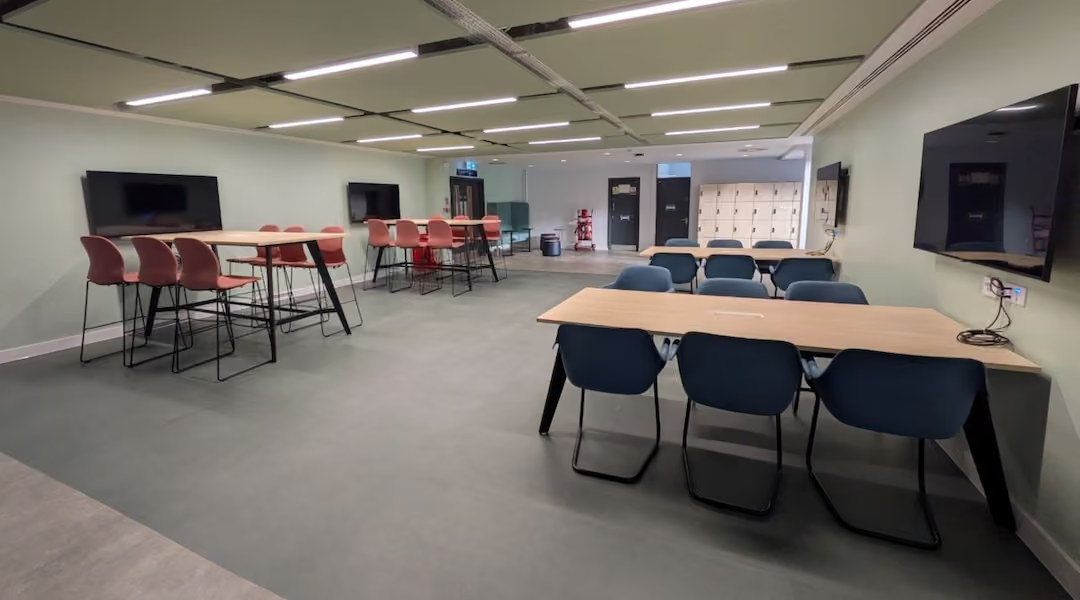
In many offices, especially older buildings with hard surfaces and high ceilings, the most practical move is modular rezoning. Use movable acoustic partitions, high-backed seating, and storage units to carve out quiet neighborhoods without touching a single wall. Put collaboration areas like team tables and café seating near circulation paths and away from focus zones. Add freestanding phone booths for video calls. Then split underused large conference rooms into two smaller 2–4 person huddle rooms.
A practical target is about one to two phone booths and one to two small huddle rooms per 50 employees [19][20]. Because these updates rely on furniture and portable partitions instead of construction, teams can usually test them zone by zone over a weekend. Quiet work zones cut down the friction that sends people back home.
Once the floor plan is divided up, the next move is to match the furniture, acoustics, and AV setup to each area.
Upgrade seating, desks, acoustics, and meeting technology together
Seating, acoustics, and meeting tech should be treated as one system. A workplace can have great video bars, but if the desks are noisy and uncomfortable, home still wins for focused work. On the flip side, ergonomic desks don't help much if meeting-room audio keeps breaking hybrid calls. These upgrades work as a system, not as individual purchases.
A Washington State Department of Labor & Industries study of 4,000 employees found that introducing ergonomic furniture led to a 40% increase in productivity, a 75% decrease in absenteeism, and a 56% reduction in error rates [22][23]. Height-adjustable desks can also reduce neck and back pain by 54% when they cut sitting time by just 66 minutes per day [22]. These upgrades need to show up across the floor, not in a few polished demo areas. Otherwise, comfort feels like a perk instead of the baseline.
On the acoustic side, ceiling baffles, wall panels, acoustic desk dividers, and area rugs help absorb sound instead of letting it bounce all over the room. In offices with exposed brick and concrete, targeted acoustic treatment is often a smart spend. Sound masking systems cost about $3 per square foot less than structural soundproofing [3], and they can usually be installed outside peak hours.
For meeting rooms, start with audio. A high-quality microphone array and even speaker coverage matter more than camera resolution, because 81% of professionals rank audio as the top video-conferencing factor [18].
When these upgrades are planned together instead of added bit by bit, the difference shows up fast.
Comparison table: before redesign vs. after redesign
Conclusion: mandates fall short when the office is not built for modern work
Office attendance has leveled off far below pre-pandemic norms, and there’s still a clear gap between what employers want and what employees actually do.
That gap isn’t hard to explain. In many cases, the office still falls short on the basic things people need to work well. If home is quieter, more comfortable, and more dependable day to day, the commute just doesn’t feel worth it.
The answer isn’t more pressure. It’s a better workplace.
When companies rezone space for focus and collaboration, improve seating and acoustics, and standardize hybrid AV, they improve comfort, satisfaction, and perceived performance - which makes office days more useful and more productive.[24][25] That’s the line between attendance people put up with and attendance they choose.
A mandate can bring people in once. A workplace designed for modern work brings them back.
At Office Gallery, we help organizations create environments that support the way people work today through thoughtful workplace design, ergonomic furnishings, integrated technology, and flexible spaces that reduce friction and improve the employee experience. When the workplace is intentionally designed around people, the office becomes more than a destination. It becomes a competitive advantage that employees choose to return to.
FAQs
Why do workers prefer home over the office?
Workers often prefer home because it gives them more control over comfort, productivity, and autonomy. A lot of people have built ergonomic setups at home that their office still doesn't match.
Open-plan offices can bring noise, interruptions, and stress. If the office doesn't offer quiet places to focus, acoustic privacy, and comfortable furniture, home will often support individual work styles better.
What office problems hurt productivity most?
Poor office design can drain productivity fast, and noise is the biggest culprit. Too much noise can cut productivity by up to 66%. And after just one interruption, it can take about 23 minutes to get fully back on track.
That’s a brutal trade-off. A few bad design choices can turn a normal workday into a stop-start grind.
Other common problems include:
- under-equipped meeting rooms
- non-ergonomic workstations and hot desking without height-adjustable surfaces
- layouts that do not align with personality types
How can companies make office days worth it?
To make office days feel worth the commute, companies need to move away from mandates and focus on workplace improvements. If the office feels less comfortable or makes focus harder than home, people will keep pushing back on RTO.
That starts with the basics: better ergonomics, more comfort, and spaces that fit different ways of working. Offices also need layouts that make casual run-ins and quick conversations easier, plus flexible areas people can adjust and make their own.
•••••
The right workplace design measurably improves employee performance, satisfaction, and retention. Office Gallery partners with businesses on that strategy, and welcomes architects and interior designers looking for a furniture and space-planning partner on their own projects. Contact the team at 781-762-3733, email info@officegallery.net, or visit the showroom at 151 Carnegie Row in Norwood.
Key Points
What does the attendance and sentiment data reveal about why current RTO mandates keep failing?
- Office attendance plateaued at roughly 54% of pre-2020 levels -- recovering to just over half its former baseline shows the shortfall is structural rather than a temporary post-pandemic lag; a workplace people would rather not use does not close that gap on its own
- A 3.2 to 2.9 day gap between what employers want and what employees deliver -- the gap compounds across every team and every week, turning the shortfall into a chronic staffing and culture cost rather than a one-time scheduling inconvenience
- Only 44% of workers said they would follow a strict five-day mandate -- a policy most of the workforce says it will not follow is not a compliance problem waiting on stricter enforcement, it is a signal the workplace has not earned the commute
- 41% said they would look for a new job and 14% said they would quit -- these numbers turn a policy decision into a retention risk, and replacing an employee typically costs 50% to 200% of that employee's annual salary, which makes a poorly received mandate far more expensive than the mandate itself
- Stricter mandates raise resignation risk by 14% -- pushing harder on attendance without addressing why the office underperforms accelerates the exact outcome the mandate was meant to prevent
- Home now beats the average office on 17 of 21 work activities -- when the comparison is this lopsided, the fix is not persuading people the office is better, it is making the office actually better on the specific activities where it currently loses
How does the noise data explain why open-plan offices undermine both focus and collaboration?
- Open-plan offices commonly measure 60 to 65 decibels against a 40 to 55 decibel ideal -- a gap of this size is not a matter of personal sensitivity, it places the average open floor plan well outside the range research identifies as workable for concentrated tasks
- 23 minutes and 15 seconds of recovery time per interruption -- at that rate, a handful of interruptions before lunch consumes the better part of a morning's cognitive capacity, making sustained focus work structurally difficult in an unzoned office
- 99% of employees say office noise hurts their concentration -- a finding this close to universal rules out individual adjustment as the answer; it points directly to the floor plan and acoustic treatment as the variables that need to change
- Speech is harder to tune out than mechanical noise -- the brain keeps trying to parse overheard words, which is why nearby phone calls and side conversations disrupt concentration more than equivalent volumes of background hum or equipment noise
- Enclosed quiet rooms, phone booths, and acoustic ceiling treatment as the direct countermeasure -- these interventions target the specific mechanism causing the productivity loss rather than treating noise as an unavoidable feature of open-plan work
- Separating heads-down work from group work as the underlying design principle -- most acoustic failure in open offices comes from forcing two incompatible activities into one shared space, and zoning by activity type addresses the cause rather than the symptom
What does the ergonomics research reveal about why comfort gaps are driving people back to home offices?
- A 1-centimeter height deviation increases muscle fatigue by 10% to 15% over an eight-hour day -- fatigue at this scale from a single, easily correctable measurement shows how much of the ergonomics problem is a specification failure rather than an unavoidable cost of office work
- Office workers spend roughly 1,700 hours a year seated at a desk -- that volume of exposure means small ergonomic shortfalls compound into real physical strain over a year rather than staying a minor daily inconvenience
- Height-adjustable desks reduce neck and back pain by 54% with just 66 fewer sitting minutes per day -- a change this achievable, requiring a modest reduction in sitting time rather than a lifestyle overhaul, is a low-friction fix with an outsized health return
- A 40% productivity increase from ergonomic furniture in a 4,000-employee study -- a sample size this large moves the finding well past anecdote, giving employers a defensible business case for ergonomic investment rather than a soft wellness argument
- A 75% decrease in absenteeism alongside the productivity gain -- pairing a productivity increase with a drop in absenteeism suggests ergonomic upgrades address a root cause of employee strain rather than just masking discomfort
- Home ergonomic upgrades built during remote years as the direct comparison point -- employees are not comparing the office to an abstract ideal, they are comparing it to a home setup they already personally upgraded, which is why an unaddressed ergonomics gap reads as a downgrade rather than neutral
What do the meeting room and technology failures reveal about the true cost of hybrid friction?
- 77% of workers have lost time to meeting room technical difficulties -- a failure rate this high means broken meeting technology is the norm employees plan around rather than an occasional exception
- 67% have abandoned video entirely after failing to get room technology working -- abandonment at this rate means the room itself is actively discouraging the hybrid participation it was installed to support
- 81% of professionals rank audio as the top video-conferencing factor -- this establishes where redesign budget should go first; camera and display upgrades matter less than solving audio if the goal is a better meeting experience
- Poor audio quality damages listeners' judgment of the speaker, not just comprehension -- this finding adds a reputational cost to a productivity problem, meaning unreliable meeting audio can quietly affect how colleagues and clients perceive the person speaking
- 63% of hybrid employees hit tech problems specifically on office days -- the failure is concentrated on the days employees are being asked to commute for, which directly undercuts the case for coming in
- 25 minutes lost just getting settled and connected after arrival -- losing half an hour before work starts is a real productivity cost stacked directly on top of the commute, compounding the case against coming in
What does the infrastructure data show about why flexible seating often fails without matching upgrades?
- 37% of employees cite slow office networks as the top connectivity problem -- a complaint this widespread indicates a network capacity issue rather than isolated user error, and it undermines every other workplace investment layered on top of it
- 29% report office Wi-Fi as a problem outright -- combined with the network complaint above, this shows connectivity failures are common enough to actively shape where and whether employees choose to work from the office
- Only about 3% of huddle rooms are properly equipped -- a figure this low means most small meeting spaces were never actually built for the hybrid use they now receive, rather than having degraded from an adequate baseline
- 50% of employees say small rooms lack basic collaboration tools -- half the workforce reporting this gap points to a systemic under-investment in small-format spaces, not a handful of neglected rooms
- Hot-desking rolled out without moving the power and display infrastructure -- flexible seating only works when the physical infrastructure is flexible too; furniture changes without matching electrical and AV planning leave employees with mobility but no functional workspace
- The fix requires building technology into the workspace rather than patching room by room -- infrastructure gaps at this scale are a planning problem, and addressing them room by room leaves the underlying gap in place for whichever space gets attention last
What does the research on zoning and system-level upgrades show about what actually reverses RTO decline?
- Moving employees to quiet zones improved cognitive performance by 16.9%, rising to 21.9% in enclosed rooms -- a nine-point difference between partial and full enclosure shows the degree of acoustic separation matters, not just its presence, which should inform how aggressively an organization zones its floor plan
- Modular rezoning achievable with movable partitions rather than construction -- this removes cost and downtime as a barrier to the single highest-impact intervention in the data, making zoning accessible to organizations that assumed a full remodel was required
- A practical target of one to two phone booths and huddle rooms per 50 employees -- a concrete ratio like this turns an abstract design principle into a specification an organization can actually plan and budget against
- Sound masking costing roughly $3 per square foot less than structural soundproofing -- a cost advantage this size makes acoustic treatment a near-term budget decision rather than a long-range capital project
- Comfort, satisfaction, and perceived performance improving together when upgrades are made as a system -- treating seating, acoustics, and meeting technology as one coordinated upgrade rather than separate purchases is what produces gains across all three outcomes simultaneously
- Attendance people choose versus attendance people tolerate as the outcome that separates a mandate from a redesign -- the data across every category points to the same conclusion, that a policy alone cannot produce the outcome a functioning workplace can produce on its own