
How Office Design Affects Employee Retention - and What It Costs When It Doesn't
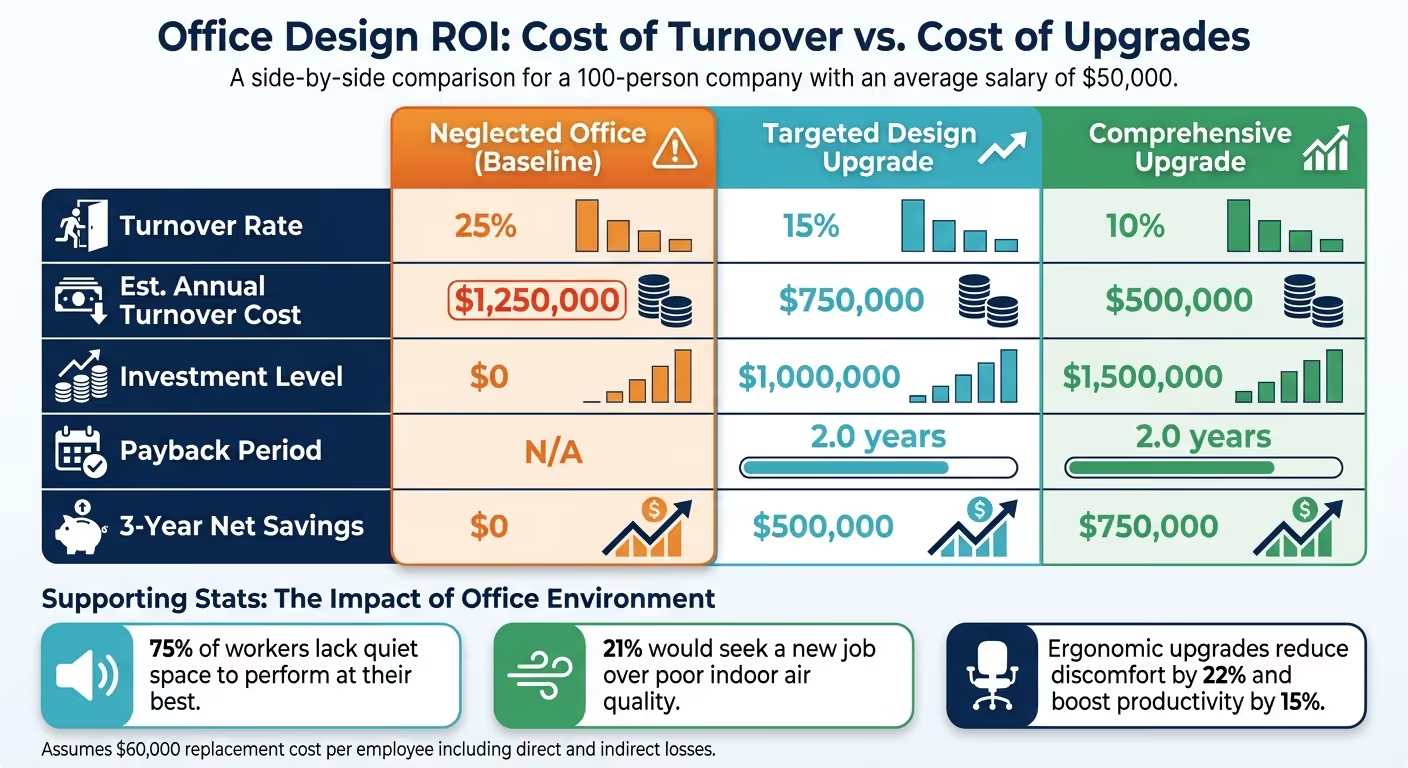
Replacing one employee costs 50% to 200% of salary. At 15% turnover in a 100-person company that is $900,000 annually. 75% of workers lack quiet space and 21% would job-hunt over poor indoor air. Dropping turnover from 25% to 15% can save $500,000 over three years — even after a $1M office upgrade. Office Gallery makes the CFO case.
Post Summary
Replacing one employee costs between 50% and 200% of annual salary when recruiting, onboarding, training, manager ramp-up time, and lost institutional knowledge are combined. In a 100-employee company with 15% annual voluntary turnover and a conservative replacement cost of $60,000 per employee, the annual turnover bill lands at $900,000. If turnover climbs to 20%, that cost jumps to $1.2 million. These are not worst-case projections — they are the baseline cost of standard turnover rates at typical salary levels. When workplace conditions are actively pushing people toward the exit, the office becomes a measurable line item in the turnover calculation rather than an overhead cost separate from the people cost.
Three categories of workplace condition consistently show up in retention research as friction points that accumulate into departure decisions. Layout and noise are the most cited — 75% of workers say they lack quiet space, employees in open-plan offices are interrupted once every three minutes, and 54% of high performers say their office is too distracting. Poor ergonomics creates physical wear that leads to fatigue, presenteeism, and absenteeism — even a 0.4-inch deviation from the correct ergonomic working height increases muscle fatigue by 10% to 15% over an eight-hour day. Indoor air quality completes the picture — 21% of employees say they would look for a new job if their employer did not address indoor air issues, and 93% say their air quality standards are higher than three years ago. None of these factors typically causes immediate departure — they accumulate slowly into a reason to leave.
The physical condition of an office sends a signal about organizational priorities regardless of whether leaders intend it to. Worn furniture, aging finishes, poor lighting, and inadequate acoustic control communicate to employees that their daily work experience is not worth investing in. This perception chips away at belonging — the psychological connection to the organization that is one of the strongest predictors of voluntary retention. A well-maintained space with quality breakout areas, access to daylight, and good air quality signals care and investment. A neglected one signals the opposite. Because these conditions are controllable, the office becomes a practical retention lever that organizations can adjust rather than a fixed environmental variable they have to accept.
Zoning, acoustics, and ergonomics are the three upgrade categories with the most direct and measurable retention and productivity returns. Zoning splits the floor plan into areas matched to different work types — open benching for team collaboration and quiet pods or partitioned areas for focus-heavy work — reducing the daily friction of noise and interruption that accumulates into departure risk. Acoustic panels, ceiling treatments, and partitions address the specific distraction that 54% of high performers identify as a primary frustration. Ergonomic furniture reduces employee discomfort by 22% and increases productivity by 15% — and preventing a single musculoskeletal injury saves $20,000 to $60,000, which in many cases exceeds the cost of the equipment that prevents it.
The ROI model for office upgrades compares the cost of the upgrade against the avoided turnover cost it produces. The baseline inputs are current turnover rate, average salary, and replacement cost estimate. From there, add vacancy duration, ramp-up time for new hires, and employee survey data on noise, lighting, and privacy complaints — the early warning signals that turnover risk is building. For a 100-person team with a $50,000 average salary, both a targeted acoustic and ergonomic upgrade and a fuller zoning plus ergonomic upgrade produce a payback period of approximately two years from avoided replacement costs alone, before productivity gains or space savings are factored in. The model becomes the evidence base for presenting the upgrade as a capital decision rather than an HR expense.
A poor office can cost you people - and losing people gets expensive fast. If turnover drops from 25% to 15% in a 100-person company, the savings can reach $500,000 over three years, even after a $1,000,000 office upgrade.
Here’s the simple version:
- Turnover is expensive: replacing one employee can cost 50% to 200% of salary
- Office problems add friction: noise, lack of privacy, poor seating, weak lighting, bad air, and uneven temperatures wear people down
- Workers notice it: 75% say they lack quiet space, and 21% would look for a new job if indoor air issues aren’t addressed
- Some fixes have clear payoff: zoning, acoustic work, and ergonomic furniture can cut distraction, reduce strain, and help people stay
- The business case is measurable: lower turnover, less lost output, fewer injuries, and lower replacement costs
Put another way: the office is not just where work happens. It can shape whether people stay, leave, or do less while they’re there.
This article breaks down the cost of turnover, the office issues that push it up, and how I’d frame workspace upgrades as a capital decision instead of “just an HR thing.”
Optimizing Employee Retention & Office Design | FT Angeline Loiseau | The Suited Realtor Podcast
What Employee Turnover Actually Costs a Business
Turnover hits a business from several angles at once: hiring, onboarding, training, and the drop in output that follows. This section looks at those costs line by line.
Direct Costs: Hiring, Onboarding, and Training
Every departure sets off a chain of expenses: recruiting, HR time, background checks, signing bonuses, onboarding, and manager ramp-up time [8]. And the meter keeps running after the offer is signed. Managers and teammates also spend hours getting the new hire up to speed.
A simple way to model replacement cost is 50% to 200% of annual salary, based on how complex the role is.
Indirect Costs: Lost Output and Knowledge Drain
Indirect costs are often bigger than the direct ones. When a seat stays empty, projects slow down, other employees take on extra work, and client relationships can take a hit. The knowledge that person carried with them - processes, client history, team dynamics - walks out the door too.
These losses are easy to miss in budget talks, even though they add up fast [8][1].
The math gets clearer in a simple replacement-cost model. Picture a 100-employee company with a 15% annual voluntary turnover rate. That means 15 departures per year. Using a conservative replacement cost of $60,000 per employee, the annual cost lands at $900,000. If turnover climbs to 20%, the cost jumps to $1.2 million.
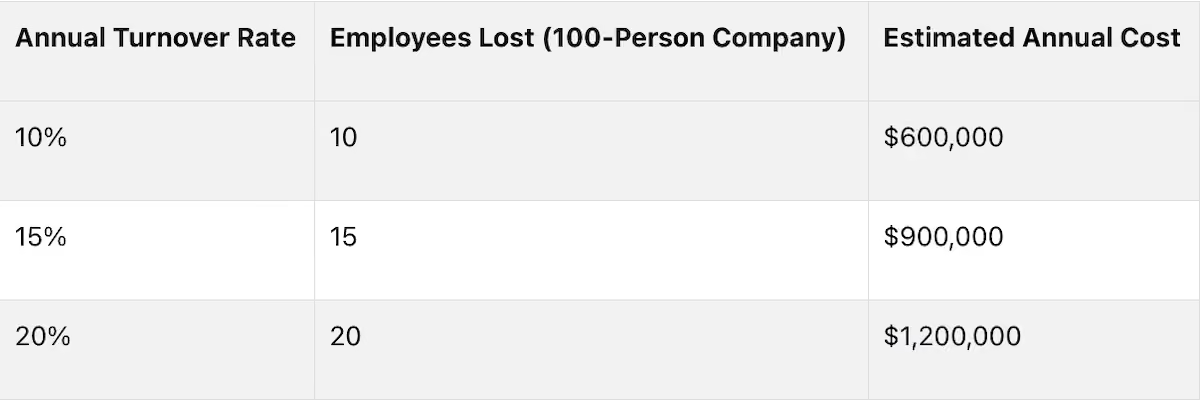
Assumes a $60,000 replacement cost per employee, including direct and indirect losses.
That’s baseline turnover risk, not some rare worst-case scenario. If workplace conditions are pushing people out, office design becomes part of the turnover bill. And when the workplace adds frustration, distraction, and exits, those costs keep climbing.
How Physical Workplace Conditions Affect Retention
People almost never quit because of one single thing. More often, it’s the slow build of daily friction at work: too much noise, physical discomfort, stale air, and layouts that make it hard to focus. Over time, those annoyances don’t stay small. They show up as resignations, absenteeism, and weaker output.
Layout, Privacy, and Noise Drive Daily Friction
A lot of workplace stress starts with the setup itself. Three-quarters of workers say they can't perform at their best because they lack quiet space [2]. In open-plan offices, employees are interrupted once every three minutes [6], and 54% of high-performance employees say their office is too distracting [6].
That helps explain why open layouts often fall short. It’s not just that they’re open. It’s that many of them don’t include quiet rooms, focus zones, or enough acoustic control. So the workday turns into a string of interruptions.
That kind of friction adds up fast. Poor design can cut productivity by up to 15% [3]. And when the space is both distracting and physically draining, the odds of people checking out - or leaving - go up.
Ergonomics, Lighting, Air Quality, and Temperature Affect Tenure
Physical discomfort works the same way: slowly, then all at once. A chair that doesn’t fit, weak daylight, uneven temperatures, or poor ventilation may not push someone out on day one. But month after month, those issues wear people down.
The result is often presenteeism. People are there, but they’re not working at full capacity.
Indoor air quality is one of the clearest examples. Poor IAQ is linked to fatigue, headaches, and impaired cognitive function. It also affects job decisions: 21% of employees say they would look for a new job if their employer didn't take steps to maintain a healthy indoor environment [4][5]. Worker expectations have also changed. 93% of workers say their standards for workplace air quality are higher than they were three years ago [4].
Better air quality helps cut fatigue, sickness, and lost productivity. Put plainly, cleaner air doesn’t just feel better. It supports day-to-day work and helps people stay.
Ergonomics adds another layer. Even a 0.4-inch deviation from the correct ergonomic working height can increase muscle fatigue by 10% to 15% over an eight-hour day [10]. That sounds tiny on paper. In practice, it means more strain, more distraction, and more absenteeism over time.
A Neglected Office Signals Low Organizational Investment
The office sends a message, whether leaders mean it to or not. Worn furniture and aging finishes don’t just look tired. They tell employees something about how much the company is willing to put into their day-to-day experience.
When a workplace feels neglected, that message can chip away at belonging. A well-kept space suggests care and investment. A run-down one suggests the opposite. Quality break-out areas, access to daylight, and good air quality help support focus, recovery, and retention [5][9].
That’s why the physical office isn’t just a cosmetic issue. It’s a controllable retention lever. And because these conditions can be changed, office design becomes a practical way to lower turnover risk. The next step is figuring out which upgrades reduce that risk fastest.
Office Design Investments That Lower Turnover Risk
The next step is picking upgrades that cut distraction, ease discomfort, and lower turnover risk. Start with zoning, acoustics, and ergonomics. Those changes remove the day-to-day friction that wears people down and nudges them toward the exit.
Zoned Layouts and Acoustic Upgrades That Reduce Distraction
The core issue is simple: too many offices force every task into the same sound environment. When the layout and acoustics don't match the work, frustration builds fast, and turnover risk goes up.
The answer is zoning. Split the floor plan into separate areas so people can work where the task makes sense. That can mean open benching for team-based work and quiet pods or partitioned cubicles for focus-heavy tasks. When the space is set up this way, collaborative work and heads-down work can happen side by side without constant friction.
Acoustic panels, ceiling treatments, and well-placed partitions do much of the work here. They also help employees who need quieter, lower-stimulation spaces.
Less friction during the day means fewer small annoyances piling up into a reason to leave.
Ergonomic Furniture That Improves Comfort and Work Endurance
Quiet helps, but comfort matters just as much.
Physical discomfort leads to fatigue, complaints, and lost output. Ergonomic furniture can reduce employee discomfort by 22% and increase productivity by 15% [10][7]. That's one of those upgrades that tends to hold up well on a spreadsheet.
The basics with the biggest payoff are height-adjustable desks and task chairs. A desk with a 22- to 48-inch height range can fit seated wheelchair users and taller standing users [10]. Task chairs with 4D armrests and lumbar support help cut back strain over an eight-hour day. Even a 0.4-inch deviation from the right ergonomic working height increases muscle fatigue by 10% to 15% over a full workday [10]. Lower strain can reduce absenteeism and help people stay productive for longer stretches.
There's also a cost case that tends to land well with CFOs. Commercial-grade furniture is made for commercial use and usually lasts 10 to 15 years. Residential-grade options often break down within one to two years in a commercial setting [3]. The upfront price is higher, sure. But total cost of ownership is often lower once you factor in replacements and the disruption that comes with them.
Preventing even one workplace musculoskeletal injury saves an organization between $20,000 and $60,000 [10].
How Office Gallery Supports Boston-Area Upgrades
Once the biggest pain points are clear, the next call is how to put the plan in place without running up avoidable costs.
Based in Norwood and serving Greater Boston since 1989, Office Gallery International provides on-site consultation, space planning, furniture selection, acoustic solutions, and installation [3][10]. Its commercial offerings cover private offices, open-plan workstations, conference and training rooms, reception areas, ergonomic seating, height-adjustable desks, and breakrooms.
Here's one example. When Jack Conway in Bridgewater, MA needed to upgrade its real estate office, Office Gallery International specified Three H workstations, SitOnIt and 9to5 task seating, and MPS Acoustic Panels to create a workspace that balanced performance with a professional environment [3].
For teams working against the clock, it also offers quick-turn products [3][10].
How to Model ROI and Build the Case for Office Upgrades
Once you know which workplace issues are pushing people out, the next step is simple: put a dollar amount on them. Upgrades like zoning, acoustics, and ergonomics cost money. But the core question isn't whether they cost money. It's whether they cost less than the turnover they help prevent.
The Numbers a CFO or Owner Should Track
Start with a baseline. Look at your current turnover rate, average salary, and time to full productivity. That gives you a working estimate of avoided cost when fewer people leave.
From there, add a few more inputs:
- Vacancy duration
- Ramp-up time for new hires
- Employee survey data on noise, lighting, and privacy complaints
Those complaints matter because they're early warning signs. If people keep flagging noise, bad lighting, or lack of privacy, that's not just office feedback. It's a signal that turnover risk may be building.
Once you have that baseline, it gets much easier to compare upgrade paths side by side. Here's how the math can look for a 100-person team with an average salary of $50,000:
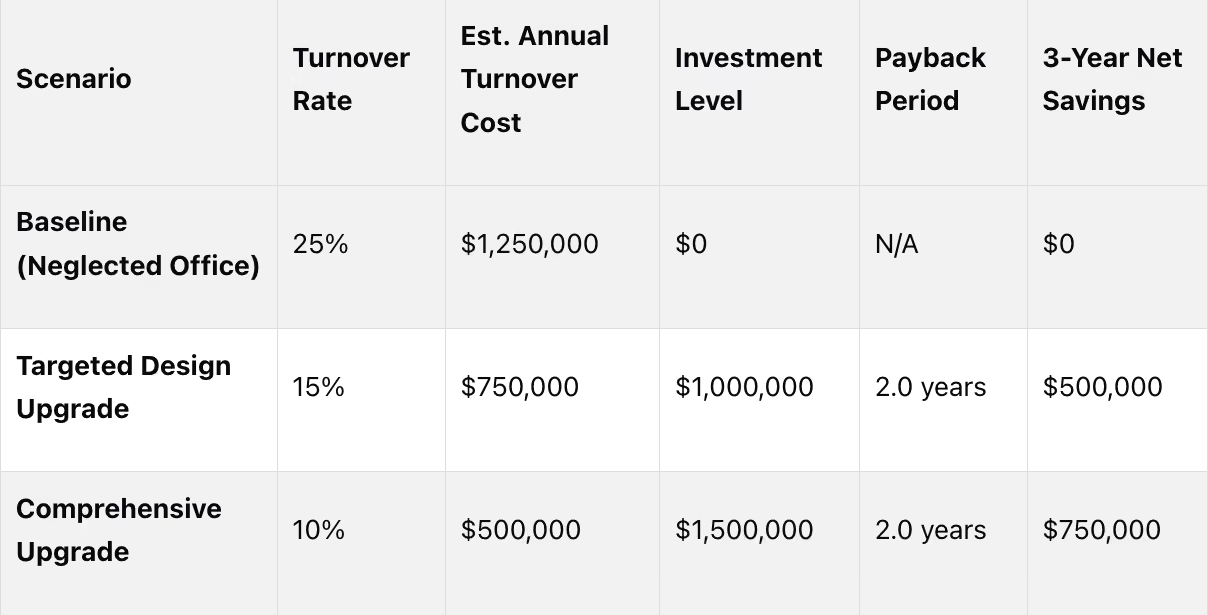
In both upgrade scenarios, the payback period comes out to about two years based on avoided replacement costs alone.
And that's only part of the picture. If you also factor in productivity gains and possible real estate savings, the business case gets stronger. Turnover savings are the first layer. Better output and space use can add even more to the model.
Conclusion: Treat Office Design as a Capital Decision
Turnover is expensive. Workplace quality affects who stays. And a neglected office can turn into a financial drag that gets worse year after year.
That's why office upgrades should be treated as a capital decision, not an HR perk. The right way to look at them is the same way you'd look at any other investment: weigh the upfront cost against the multi-year savings from lower turnover, faster ramp-up, and less lost productivity.
FAQs
How do I calculate turnover cost for my company?
Calculate turnover cost by adding both the direct and indirect costs of replacing an employee who leaves. That includes:
- recruitment expenses
- onboarding and training time
- lost institutional knowledge
- reduced productivity during ramp-up
When you track these costs, you get a clearer, data-based view of turnover risk. It also becomes much easier to justify spending on workplace design that helps people stay and protects your bottom line.
Which office upgrades have the fastest payback?
Ergonomic furniture - especially height-adjustable desks and chairs with adjustable lumbar support - often delivers the fastest payback.
Why? The math is pretty straightforward. These upgrades can increase productivity by 15%, reduce discomfort by 22%, and cut sedentary time. On top of that, avoiding just one musculoskeletal injury can save $20,000 to $60,000 - which, in many cases, is more than the cost of the equipment itself.
There’s also a small step that can make a big difference: setup. Spending 15 to 30 minutes per user to adjust the desk and chair properly can improve comfort scores by 20% to 30%.
How can I tell if office conditions are hurting retention?
Watch for signs that people are frustrated or getting less done. One simple way to spot problems is to run informal surveys and ask where the space falls short. You may find issues like underused boardrooms, too few private areas, too much noise, constant interruptions, poor indoor air quality, or not enough quiet space.
It also helps to check whether your layout fits the way people actually work. If the design doesn’t match different work styles, it can drag performance down. Open-plan offices are a common example. When they’re set up poorly, they can cut productivity by up to 15% and lead to higher turnover.
Key Points
Why should employee turnover be modeled as a financial risk rather than an HR metric and what does the full cost picture look like?
- $900,000 annual turnover cost at 15% turnover in a 100-person company establishing the financial scale -- at a conservative $60,000 replacement cost per employee, 15 annual departures produce a cost that rivals most organizations' annual facilities budgets; framing turnover as a financial risk rather than an HR metric changes the budget conversation from overhead allocation to risk management
- 50% to 200% of annual salary as the replacement cost range covering the full complexity spectrum -- simpler roles at the lower end of this range are expensive to replace; complex, specialized, or senior roles at the upper end are dramatically more so; organizations that model turnover cost at the average rather than by role type consistently underestimate the financial exposure from their most impactful departures
- Indirect costs exceeding direct costs in most turnover scenarios -- the recruiting, onboarding, and training costs that appear in direct turnover models are typically smaller than the indirect costs of lost institutional knowledge, slowed projects, redistributed workload on remaining employees, and client relationship disruption; these indirect costs are harder to quantify but real and significant
- Eight months to full productivity for new hires extending the financial impact of every departure -- the replacement cost model that ends at the point of hire underestimates the actual financial impact; eight months of sub-full-productivity from each new hire represents a sustained output gap that compounds the direct replacement cost and extends the financial consequence of every departure across the following year
- Turnover at 20% costing $1.2 million versus $900,000 at 15% making the five-point differential worth $300,000 -- this specific comparison makes the financial value of a five-point retention improvement concrete and comparable; a $300,000 annual saving from a five-point turnover reduction is a measurable return that makes even significant workplace investment defensible on a three-year payback model
- The office as a controllable retention variable distinguishing it from other turnover drivers -- compensation, management quality, and career development are all significant turnover drivers, but many of them are difficult or expensive to change quickly; the physical workplace is a controllable variable that can be systematically improved through specific investments with predictable outcomes, making it a practical risk management lever alongside the others
How do layout, noise, and acoustic conditions specifically accumulate into departure risk over time?
- 75% of workers lacking quiet space establishing the majority-scale nature of the focus environment failure -- this is not a minority preference issue affecting noise-sensitive employees; three-quarters of the workforce identifies lack of quiet space as a performance constraint, making acoustic zoning an intervention that scales across the team rather than addressing an edge case
- One interruption every three minutes in open-plan offices preventing sustained cognitive work -- at this interruption frequency, the cognitive state required for complex knowledge work is structurally inaccessible; the employee who cannot do their best work in the office and can achieve it at home has a daily rational case for remote work that accumulates into a preference for hybrid or fully remote arrangements
- 54% of high performers identifying their office as too distracting establishing noise as a retention risk specifically among the most valuable employees -- the employees most likely to have options and to act on dissatisfaction are disproportionately the high performers whose departure is most costly; when the office environment consistently prevents high performers from working effectively, the retention risk is concentrated precisely where it is most financially consequential
- Poor design cutting productivity by up to 15% creating a measurable output gap alongside the retention risk -- the retention risk of poor acoustic design does not operate in isolation from its productivity impact; organizations absorbing a 15% productivity reduction from distraction are simultaneously losing output from present employees and accumulating the departure risk that will produce replacement costs; both costs run simultaneously
- Acoustic panels, ceiling treatments, and partitions addressing distraction at the source -- these interventions reduce the ambient noise level and interrupt the direct transmission paths that carry conversation noise across the open floor; they are the specific acoustic tools that convert a distracting environment into one where the productivity gap and the retention risk are simultaneously reduced
- Zoning as the layout intervention that allows collaborative and focused work to coexist without friction -- acoustic treatment alone does not solve the layout problem of placing high-noise collaborative work adjacent to focus-work positions; zoning physically separates these work modes into different areas, addressing the noise problem through spatial design rather than only through material treatment
How do ergonomics, air quality, and physical comfort conditions affect retention and what are the specific thresholds that matter?
- 0.4-inch ergonomic working height deviation increasing muscle fatigue by 10% to 15% over an eight-hour day -- this specific threshold establishes that ergonomic inadequacy does not require obvious physical failure to produce measurable physical consequence; sub-centimeter misalignments from correct working height produce compounding fatigue that affects daily comfort, sustained output, and over time the physical wellbeing that influences tenure decisions
- 21% of employees willing to seek new employment over unaddressed indoor air quality issues -- this finding elevates air quality from a facilities management concern to a retention risk variable; one in five employees treating air quality as a job search trigger means organizations whose buildings have documented IAQ issues are incurring a measurable retention cost from a condition they may not be monitoring
- 93% of workers reporting higher air quality standards than three years ago establishing the expectation shift -- the post-pandemic elevation of employee expectations for physical workplace health means that facilities standards that were acceptable in 2019 are retention risks in 2026; organizations that have not updated their physical workplace standards are operating against a raised employee expectation baseline
- Ergonomic furniture reducing discomfort by 22% and increasing productivity by 15% -- these paired outcomes establish ergonomic investment as a simultaneous comfort and productivity intervention; the discomfort reduction addresses the retention risk directly while the productivity increase provides the additional return that strengthens the capital investment case
- $20,000 to $60,000 saved per prevented musculoskeletal injury making ergonomic furniture a risk management purchase -- at this prevention value per incident, the comparison between ergonomic furniture cost and injury cost avoidance frequently produces positive ROI from injury prevention alone, before the productivity and retention returns are added to the model
- Commercial-grade furniture lasting 10 to 15 years versus residential-grade lasting one to two years -- the total cost of ownership comparison between commercial and residential-grade furniture consistently favors commercial specification when replacement frequency and disruption cost are included; the higher upfront cost of commercial-grade furniture is a one-time capital cost while the replacement cycle of residential-grade furniture is a recurring cost that compounds over the furniture lifecycle
How does the office signal organizational investment and why does this perception affect belonging and retention?
- The office as a visible and daily signal of how much the organization values the employee experience -- unlike compensation or title, which employees reference periodically, the physical workplace is experienced continuously across every working hour; its quality signal operates constantly, reinforcing or undermining the employee's perception of organizational investment in their daily experience
- Worn furniture and aging finishes communicating neglect regardless of leadership intent -- the signal the office sends is independent of whether leaders intend to send it; an office with worn furniture, poor lighting, and inadequate acoustic control communicates that the employee's daily environment was not worth updating, even when the decision was driven by budget constraints rather than organizational indifference
- Belonging as the psychological mechanism connecting office quality to retention -- belonging — the sense of being valued and invested in by the organization — is one of the strongest documented predictors of voluntary retention; workplace quality influences belonging through the daily message it sends about organizational care, making office investment a belonging investment as well as an environmental one
- Quality breakout areas, daylight access, and air quality as the specific environmental factors linked to focus, recovery, and retention -- these are not general aesthetic improvements; they are the specific environmental factors that research connects to the cognitive recovery, physical comfort, and psychological wellbeing that support both sustained performance and the belonging that reduces departure risk
- The neglected office as a competitive disadvantage in talent markets where workplace quality is a differentiator -- in Greater Boston's competitive talent market, organizations whose offices communicate care and investment attract and retain candidates more effectively than those whose environments communicate neglect; the workplace quality signal operates in recruitment as well as retention, affecting the talent pipeline as well as the departure rate
- The controllability of workplace conditions making them a practical retention lever alongside harder-to-change factors -- compensation increases are constrained by budget; management quality improvements take time; career development opportunities require organizational structure changes; the physical workplace can be specifically, systematically, and relatively quickly improved through targeted investment, making it one of the most actionable retention levers available to leadership
How should the office upgrade ROI model be constructed to make the capital investment case to a CFO or business owner?
- Baseline turnover rate, average salary, and replacement cost as the three required inputs that anchor the model -- without a documented baseline, the ROI model is a projection without a reference point; organizations that capture their current turnover rate, average salary by role, and replacement cost estimate before implementing any changes have the data needed to demonstrate the financial return of those changes after implementation
- Vacancy duration and ramp-up time as the inputs that capture the full replacement cost beyond direct expenses -- vacancy duration is the period during which the position produces no output; ramp-up time is the period during which the replacement produces reduced output; both represent real payroll cost for reduced or zero productivity that the direct replacement cost model omits
- Employee survey data on noise, lighting, and privacy as the early warning signals that quantify building retention risk -- these complaints are not generic feedback; they are measurable signals that retention risk is accumulating in specific environmental dimensions; organizations that track these complaints alongside turnover data can identify the correlation between environmental friction and departure patterns that makes the investment case specific rather than general
- Two-year payback period from avoided replacement costs alone establishing the financial defensibility of targeted upgrades -- the payback model for acoustic and ergonomic upgrades in a 100-person team at $50,000 average salary produces full return within two years from turnover savings alone; this payback period is shorter than most capital equipment investments and does not include the additional return from productivity gains or space savings
- Productivity gains and real estate savings as the second and third layers of ROI beyond turnover savings -- the retention-focused ROI model is the most direct and defensible capital case, but it understates the full return; productivity improvements from reduced distraction and improved ergonomics, and space savings from right-sizing utilization, add additional financial return that strengthens the multi-year model
- The Jack Conway case as a reference point for how the Office Gallery process works in practice -- when Jack Conway in Bridgewater needed to upgrade its real estate office, Office Gallery specified Three H workstations, SitOnIt and 9to5 task seating, and MPS Acoustic Panels as a coordinated solution addressing both performance and professional presentation; the process began with the workspace problem and ended with an installed environment — the same sequence the ROI model describes
What is the practical sequence for Boston-area organizations moving from retention risk identification to office upgrade implementation?
- Retention risk audit as the starting point that identifies which workplace conditions are contributing to departure decisions -- informal surveys asking where the space falls short surface the specific friction points — noise, lighting, privacy, air quality, ergonomic inadequacy — that are accumulating into retention risk; this audit provides both the investment prioritization data and the before-measurement baseline that makes the post-investment ROI calculation possible
- Upgrade prioritization based on the highest-return friction point categories -- zoning and acoustics address the distraction and privacy issues that affect 75% of workers and 54% of high performers; ergonomic furniture addresses the physical discomfort that produces the $20,000 to $60,000 per-injury prevention value; air quality and lighting improvements address the 21% departure risk from IAQ issues; prioritizing these in order of their documented retention impact concentrates investment where the return is highest
- Capital framing of the upgrade conversation that connects to CFO decision-making language -- presenting upgrades as capital investments with a two-year payback period, a quantified annual return from avoided replacement costs, and a multi-year compounding benefit from retention improvement changes the budget conversation from discretionary spend to capital allocation; this framing belongs in the investment committee or board presentation, not only in the HR or facilities budget review
- Phased implementation allowing early-phase ROI to fund later phases -- organizations that implement the highest-return acoustic and ergonomic upgrades first and measure the three and six month retention and productivity improvement can use the documented return from phase one to justify the investment in phase two; this sequencing allows the ROI case to be built from evidence rather than projection
- Quick Turnaround Products for organizations with compressed timelines -- Office Gallery's Quick Turnaround collection provides commercial-grade acoustic and ergonomic furniture on faster delivery timelines than standard custom orders, allowing organizations with urgent retention concerns or compressed move-in timelines to implement improvements without waiting on standard lead times
- On-site consultation with Office Gallery as the practical next step for Greater Boston organizations -- the consultation begins with the specific workplace conditions contributing to retention risk in the actual space, not with a product catalog; Office Gallery's team at 151 Carnegie Row in Norwood provides space planning, furniture selection, acoustic solutions, and full installation management for businesses across Beverly, Marlborough, Plymouth, Quincy, Waltham, and Greater Boston; contact the team at 781-762-3733 to begin