
What Design Firms Should Know About Quick Turnaround Furniture Before a Deadline Crunch
A quick-ship label doesn’t tell you when a team can use the furniture. This guide helps design firms verify stock and holds, work backward from the ready-for-use date, confirm Boston-area site access, and document backup plans before agreeing to an earlier office opening.
Post Summary
Ask for a dated, written inventory check that lists the exact manufacturer, product number, dimensions, finish, fabric, quantity, and storage location. Treat “available” as verified stock in the specified configuration, not a catalog listing. Without a confirmed hold, treat the item as unreserved, and check availability again before issuing the purchase order.
Verified in-stock furniture carries the lowest availability risk but the least design flexibility. Quick-ship items are low to moderate risk, standard production is moderate to high, and custom or imported orders carry the highest and most variable risk. Use in-stock items for day-one needs and custom orders only when the schedule can absorb the risk.
Start with the date the space must be usable, then work back through approvals, production, shipping, receiving, installation, inspection, and punch-list completion. The slowest confirmed lead time sets the installation date, not the average. Confirm what starts each lead time, and label each date as estimated or committed.
Assign one person to approve site readiness and require a written yes or no on each item 48 to 72 hours before the first truck. Confirm dock times, elevator reservations, building paperwork, and after-hours permissions. Check that floor boxes, electrical feeds, and data outlets match the latest furniture plan.
Send one package with the ready-for-use date, site address, floor plan, quantities, finishes, budget, acceptable substitutions, approval contacts, and building restrictions. Ask for written answers on what is in stock, what can be reserved, when it can ship and arrive, and the earliest realistic installation window. Review the pieces in person when comfort, finish, or scale matter.
We’d confirm stock and installation dates before agreeing to an earlier office opening. A “quick-ship” label doesn’t tell you when your team can use the furniture.
For a Boston-area project, Office Gallery will check four things:
- Stock and backups: Verify exact sizes, finishes, and quantities, secure written holds, and approve substitutes.
- The schedule: Work backward from the ready-for-use date, with time for freight, assembly, inspection, and repairs.
- Site access and labor: Book the dock, elevator, and installation crew. Recheck site readiness 48–72 hours before delivery.
- Costs and approvals: Share plans, budget, and building rules; confirm charges, decision deadlines, and who owns each step.
Our rule: plan for furniture that’s ready to use - not just delivered. Keep estimated dates separate from confirmed commitments, and document the backup plan before placing the order.
1. Check Inventory and Approve Substitutions
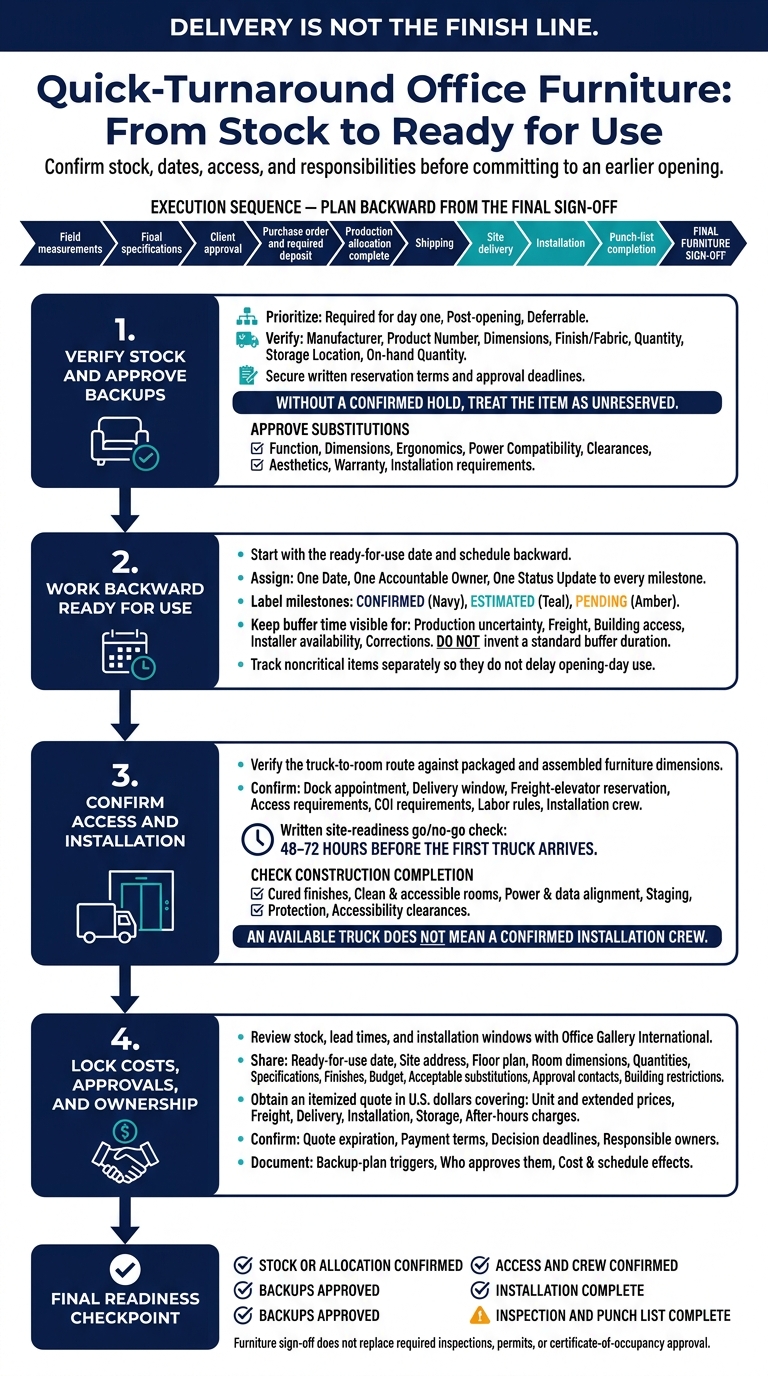
When the deadline moves up, focus on what needs to work on day one. Build a priority list before committing to the date. Label each item as required for day one, post-opening, or deferrable, and have the client approve which spaces must function at opening.
Put workstations, task seating, reception furniture, conference tables, power components, and required storage first. Defer decorative seating, accessory tables, supplemental storage, and expansion pieces.
Ask What Is in Stock and Can Be Reserved
Ask Office Gallery for a dated, written inventory check. It should include the exact manufacturer, product number, dimensions, finish, fabric, quantity, storage location, and on-hand quantity.
“Available” should mean verified stock in the specified configuration - not simply a catalog listing. Confirm whether the units are physically on hand, whether they’re already allocated, and whether stock levels can change before payment or approval.
Document the reservation period, deposit or payment requirement, approval deadline, cancellation terms, and conditions that would release the hold. Without a confirmed hold, treat the item as unreserved. Assign someone to report inventory changes, and check availability again before issuing the purchase order.
Compare Stock and Order Options
Use this table to plan, not as a lead-time promise. Actual timing depends on specifications, inventory location, freight, and installation capacity.
Record Specifications and Approve Backup Choices
For each line item, record the manufacturer, product number, description, dimensions in inches, finish or fabric, quantity, and unit and extended prices in U.S. dollars.
Include the storage location, availability-confirmation date, reservation status, and ship, delivery, and installation dates. Record the responsible supplier contact, internal project owner, client approval status, substitution status, and decision deadline. Request written ship and arrival dates, and label each date as estimated or committed.
Name one client approver, one design-firm lead, and one budget approver. Before approving a backup, check its function, dimensions, ergonomics, power compatibility, clearances, aesthetics, warranty, and installation requirements against the original choice. For workstations, verify the required monitors, task equipment, cable management, and electrical connections.
Keep written approval and the decision deadline with the specification. Use that approved list to build the delivery schedule.
2. Work Backward From the Ready-for-Use Date
When a deadline moves up, the schedule - not the furniture order - becomes the bottleneck. Delivery is not the finish line. Start with the ready-for-use date, then work backward through approvals, production, shipping, receiving, installation, inspection, and punch-list completion. Track noncritical items separately so they don’t hold up opening-day use.[9]
Once stock is confirmed, map out the remaining steps to installation.
Assign Dates and Owners to Each Milestone
Confirm what starts each lead time: order entry, a cleared deposit, approved shop drawings, or another event. Then confirm where it ends: production completion, shipment, or arrival. These commitments aren’t interchangeable. Production time alone does not include freight, receiving, or installation.[7][8]
Use this worksheet with Office Gallery before committing to a date. Record one date, one owner, and one status update for every milestone.
Set a Buffer for Project Risks
Record each supplier’s quoted lead time and latest acceptable arrival date. Add buffer days for production uncertainty, freight, building access, installer availability, and corrections. Keep that margin visible in the schedule, and review it whenever a milestone slips.[10]
If no usable buffer remains, document the risk. Get written approval for substitutions, phased installation, or a reduced opening-day scope, including added costs and limits on use. Keep furniture readiness separate from occupancy approval: furniture sign-off does not replace required inspections, permits, or certificate-of-occupancy approval from the appropriate authorities.[1][2]
With the timeline set, confirm site access and installation windows.
3. Confirm Site Access and Installation Availability
Once the schedule is set, confirm building access and installation labor before booking delivery. A truck can’t solve blocked access, an unfinished room, or a missing crew. Ask Office Gallery to confirm what can ship now and what can be installed within the approved building window.
Check the Site Before Booking Delivery
Verify that the site can accept the shipment. Measure the full truck-to-room path in feet and inches, including the loading dock, door openings, corridor turns, freight-elevator doors and cab, and overhead obstructions. Compare these clearances with both packaged and assembled furniture dimensions.
Get written confirmation of the dock appointment, delivery window, freight-elevator reservation, check-in procedure, access credentials, COI requirements, labor rules, and after-hours charges.
Assign one person to approve site readiness, with a written go/no-go check 48–72 hours before the first truck arrives.[12] Confirm that construction is complete, finishes are cured, debris is removed, and rooms are clean, dry, and accessible.
Check that floor boxes, electrical feeds, and data outlets match the latest furniture plan. Identify staging space, floor and elevator protection, and carton-removal routes. Verify accessibility clearances before furniture placement, not after furniture blocks the route.
Track Delivery, Installation, and Repairs Separately
Use one matrix to track each supplier and furniture package. Include the ship date, expected arrival date, latest acceptable arrival date, delivery appointment, installation date and sequence, dock and elevator reservation status, site-readiness status, crew confirmation, and accountable owner.
Record open issues and next steps, too. An available truck does not mean a confirmed installation crew.
Before dispatch, assign responsibility for receiving, carton counts, inspection, shortage and damage reporting, photographs, carton removal, and punch-list corrections. Confirm who approves repairs or replacements and who schedules return trips.
Share changes with the design firm, client, building manager, furniture partner, and installers so missed access windows or damaged parts trigger the next step immediately.
4. Review the Schedule With Office Gallery
Once access is confirmed, ask Office Gallery to verify stock, lead times, and installation windows. Check that your procurement plan still fits the earlier deadline.[3][14]
Share Project Details Before Setting a Date
Send all project details in one package: the ready-for-use date, site address, floor plan, room dimensions, quantities, specifications, finishes, budget, acceptable substitutions, approval contacts, and building restrictions.[3][14]
Ask for written answers for each exact product, finish, size, and quantity:
- What is in stock?
- What can be reserved, and when?
- When can it ship and arrive?
- What is the earliest realistic installation window?
Request an itemized quote in U.S. dollars showing unit and extended prices, plus freight, delivery, installation, storage, and after-hours charges. Confirm when the quote expires and the payment terms so approval delays don’t derail the proposed schedule.[3][4]
Resolve Selections With Local Planning Support
If the costs fit your budget, review the actual pieces in person before approving the order. Visit the showroom at 151 Carnegie Row, Norwood, MA 02062, to check seating comfort, finish, and scale - and avoid late selection changes. Book the visit directly; items on the showroom floor are not reservable stock.[5][13]
Request an on-site consultation if site dimensions or existing conditions could affect furniture fit. Before approving the final layout, use space planning, CAD layouts, and 3D visualization to check conference-table placement, seating arrangements, and how furniture aligns with power and data connections. These checks help prevent rework.[1][4][14] Save the approved layout and finish choices in the project file.
Conclusion: Confirm Stock, Dates, and Responsibilities
Before release, run one final check. Before committing to a deadline, confirm which items are in stock or allocated and which remain unconfirmed. Approve backups for schedule-critical pieces, and build the timeline around the item with the longest lead time.[6][11][15]
Then lock the execution plan. Label each milestone confirmed, estimated, or pending, and assign one owner to its risks. Treat delivery, installation, and final sign-off as separate milestones. Recheck site readiness and access 48–72 hours before installation.[6][2]
Document what triggers the backup plan, who approves it, and how it affects cost and schedule. This lets the team use an approved substitute or open in phases without making those decisions under pressure.[1][2]
FAQs
What should we do if our furniture delivery slips?
Contact your Office Gallery representative right away at 781-762-3733 or info@officegallery.net to discuss your delivery status. Quick Turnaround products are prioritized for speed, but inventory shortages or temporary delays can still occur.
The team will work to source your item or find a substitute you agree to so your project stays on track. Share any schedule changes as soon as possible so the team can adjust logistics and limit disruption to your deadline.
How much contingency should we budget for rush orders?
Plan around manufacturer lead times, confirmed directly with your furniture partner, rather than using a generic contingency percentage. Availability changes, so ask for current delivery estimates instead of relying on published timelines.
If your deadline is tight, ask about quick-turn options. These offer faster availability but fewer configuration choices. Track production, delivery, and installation dates separately in your project schedule.
When should we switch to a phased office opening?
Use a phased office opening if employees need to move in before the whole space is finished or stay on-site during a workplace transformation. Open each zone as it passes inspection to help limit disruptions to daily work.
Before releasing orders, approve which spaces will open first and set any temporary limits. Coordinate temporary seating, IT support, and employee notifications for each zone’s opening.
•••••
The right workplace design measurably improves employee performance, satisfaction, and retention. Office Gallery partners with businesses on that strategy, and welcomes architects and interior designers looking for a furniture and space-planning partner on their own projects. Contact the team at 781-762-3733, email info@officegallery.net, or visit the showroom at 151 Carnegie Row in Norwood.
Key Points
How do you verify that quick-turnaround furniture is really available?
- Quick Turnaround defined: Office Gallery’s Quick Turnaround program designates specific configurations for faster delivery, in exchange for a more defined selection.[3]
- Confirm availability: The team will confirm current availability for the products you need and provide a delivery timeline for your location.[3]
- Request a written check: Ask for a dated inventory check listing the manufacturer, product number, dimensions, finish, fabric, quantity, storage location, and on-hand quantity.
- Verified means on hand: “Available” should mean verified stock in the specified configuration, not simply a catalog listing.
- Document the hold: Record the reservation period, deposit or payment requirement, approval deadline, cancellation terms, and conditions that release the hold.
- Recheck before ordering: Check availability again before issuing the purchase order, since stock can change before payment or approval.
How do stock, quick-ship, standard, and custom options compare?
- Verified in-stock: This option carries the lowest availability risk when inventory is held and freight and installation are booked, but it is usually limited to available finishes, fabrics, sizes, and quantities.
- Quick-ship, confirmed in stock: Risk is low to moderate, since freight, allocation, and installation can still affect timing.
- Standard production: Risk is moderate to high because production, freight, and receiving add dependencies, though it offers more choices of finishes, sizes, and accessories.
- Custom or imported: Risk is the highest and most variable, with the most design flexibility, so use it only when the schedule can absorb the risk.\
- Production isn’t delivery: One industry guide notes that quoted lead times are production times only, and shipping, receiving inspection, and warehousing add to the total.[8]
- Match option to item: Use verified in-stock furniture for day-one items and standard production for noncritical items or schedules with buffer.
How do you work backward from the ready-for-use date?
- Plan backward: Plan furniture backwards from the date desks must be in use, subtracting the supplier’s committed manufacturing time, delivery, and installation.[11]
- The slowest item rules: The installation date is set by the longest lead time on the schedule, not the average.[6][9]
- Know when the clock starts: One supplier guide counts lead time from approved shop drawings and fabric receipt rather than first inquiry, so confirm the start event in writing.[7]
- Delivery isn’t the finish line: Work back through approvals, production, shipping, receiving, installation, inspection, and punch-list completion.
- Manage schedule risk: Federal schedule guidance calls for a risk analysis to set the reserve of time needed, and for continual monitoring so forecast dates that drift from the baseline stay visible.[10]
- Label every date: Mark each date as estimated or committed, and keep estimates separate from confirmed commitments.
How do you confirm site access and readiness before delivery?
- One written go/no-go: Require a yes or no answer for each readiness item 48 to 72 hours before the first truck.[12]
- Access bookings: Confirm dock times, elevator reservations, certificates of insurance, after-hours permissions, and security access.[12]
- Electrical match: Make sure rough-ins are complete and that floor boxes, wall feeds, and dedicated circuits match the latest furniture plan.[12]
- Clear installation zones: Keep wet finishes, curing adhesive, ceiling tile replacement, and active punch work out of installation zones.[12]
- Name a readiness approver: Office Gallery’s guidance calls for naming one readiness approver before the first delivery and running a readiness check 48 to 72 hours before installation.[2]
- Measure the path: Measure the full truck-to-room route, including the dock, doors, corridor turns, and freight elevator, against both packaged and assembled furniture dimensions.
What should you ask your furniture partner before setting a date?
- Share the basics: Office Gallery asks buyers to share room dimensions and timeline when requesting Quick Turnaround availability.[3]
- Send one package: Include the ready-for-use date, site address, floor plan, quantities, finishes, budget, acceptable substitutions, approval contacts, and building restrictions.
- Ask in writing: Request answers on what is in stock, what can be reserved and when, when it can ship and arrive, and the earliest realistic installation window.
- Check fit digitally: Office Gallery’s design guidance uses CAD layouts and 3D views to check spatial relationships before approval.[1]
- Confirm on site: During the site visit, confirm measurements, how people use the space, and installation constraints.[1]
- Sit before you specify: Office Gallery recommends a showroom sitting evaluation at its Norwood location before a multi-unit seating order.[5]
What should be in place if the schedule slips?
- Know the options: When an item will miss its window, options include expedited production, an agreed substitute, or phased installation.[6]
- Approve substitutions first: Require design approval before any substitution is ordered, with the cost, availability, finish, and functional trade-offs spelled out.[1]
- Document the trigger: Record what triggers the backup plan, who approves it, and how it affects cost and schedule.
- Phase the opening: The client approves which spaces open first and any temporary limits before orders are released, and each zone opens after its punch-list check.[2]
- Keep sign-off separate: Furniture verification stays separate from architectural, code, and engineering approvals.[1]
- Communicate quickly: Share changes with the design firm, client, building manager, furniture partner, and installers so missed access windows or damaged parts trigger the next step immediately.